

Jessica Gregory is a fourth-year PhD researcher with the University of Kent. In the summer of 2025, she took a three-month placement with The National Archives in Kew, London, where she joined their research team on a project to expand their existing knowledge of hospital-related records within their collections.
During the wonderfully sunny months of the summer of 2025, I took a PhD placement at the UK’s central repository for historic and contemporary state records, The National Archives. This opportunity was one of the research opportunities available through my Collaborative Doctoral Partnership, a PhD programme that fosters research and engagement through partnerships with heritage, museum and gallery institutions. Placements such as mine, emphasise the importance of developing additional skillsets outside of traditional academia. They expose researchers to the processes, concerns and outputs of heritage organisations with the aim of both introducing researchers to the possibilities available to them within the sector and capitalising on their unique skills to produce new content or projects.

The National Archives in Kew, London. Photo Jessica Gregory
Placements emphasise the importance of working outside of your usual topic of focus, so my time at The National Archives was a good opportunity to take a break from my day-to-day examination of indecent advertisements and the record of their interception. Instead, this three-month project focused on the occurrence and research potential of records within The National Archives which related to hospitals and health care provision more generally. The core aims of the project was to scope the existing relevant collections and draw out a summary of them for the Research Team to further develop content for their readers. Alongside this, I was working on establishing the provenance history of a legacy dataset called HOSPREC. This was a working index of hospital records and where they were held in the UK more widely. It summarised hundreds of hospitals throughout the UK, their histories and the extent and location of their records. This was an invaluable dataset for all kinds of researchers, from professionals working in the medical humanities to amateur family-history researchers, but the dataset had not been updated since 2012. I worked to explore the potential to revitalise and improve accessibility to this important resource. I developed a workshop for interested and invested partners through which we could together develop options for realising HOSPREC’s potential.
These two central aims of the placement bought me into contact with primary source material that spanned hundreds of years. The study bought me into contact with collections dated from as early as 1100, in the shape of medieval deeds and scrolls, and the latest took me up to the captures of hospital websites published within the last year. Summarising content from across ten centuries was a unique and complex task for someone who usually focuses on fifty years of history.
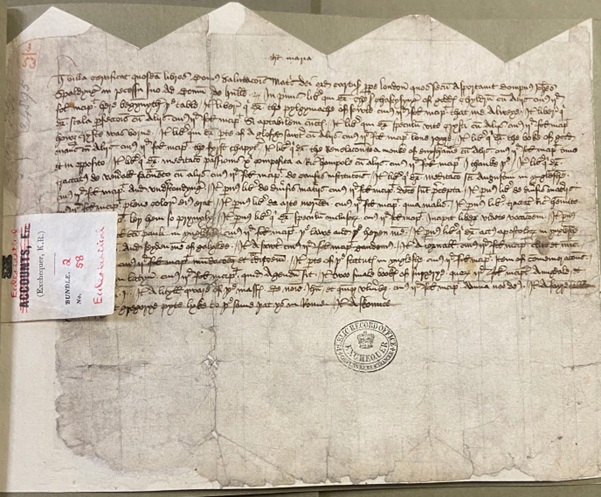
Medieval hospital collections at E 135/2/51: Rights of the Leper Hospital at Maiden Bradley 1347
My initial focus centred on locating applicable record sets within the catalogue. A search for ‘hospital’ produced closed to half a million results, indicating some of the scale and breadth of collections. I applied archival research skills to consolidate records into representative groups and then summarised the upper-level groups of records relevant to different time periods. Such research exposed some illuminating patterns and details about the developments of hospitals in Britain through the last one thousand years.
The data provided by a catalogue exposed the expansion of hospitals as a feature of modern medicine. The occurrence of records increases substantially in the eighteenth century as compared to the preceding century and catalogue ‘hits’ then double for the nineteenth century. There were less numerous records in comparison for the twentieth century. Although state-based healthcare was more expansive than ever from the twentieth century onwards, the institutional oversight of such care meant that there was a decrease in the overall production of records in compared to the multifaceted entities involved in the great expansion of the hospital system in the nineteenth century.
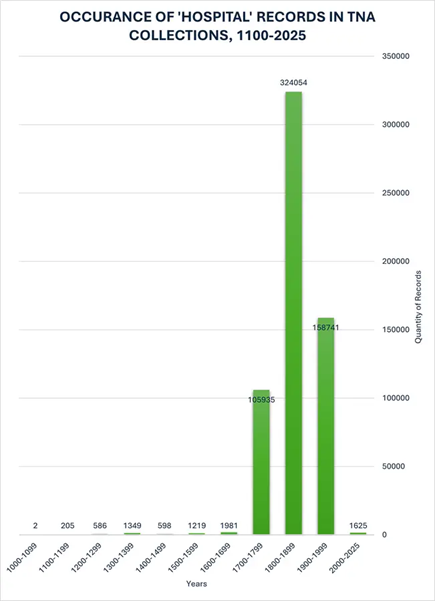
Graph by Jessica Gregory
My research also exposed some sources of records in departments of government that researchers might not initially consider after the Ministry of Health records. For example, The War Office and Admiralty record fonds contain a significant number of records reflecting the role the military had in developing systems of healthcare as it was essential to their wider aims. The Chancery records in its oversight of lands, property, taxes amid other responsibilities contains references to hospitals and their administration over the centuries. Some of the findings of this placement are available through the content I produced for The National Archives website. A summary of how to discover hospital-related records is available via the blog and a more specific investigation into records relating to hospital ships is available via their Health and Welfare content.
I found this placement was an enjoyable and fascinating way to contribute to the aims of such an important national institution. I would recommend such placements to other CDP and other history PhD students as a means of learning more about how history research might be utilised outside of academia and how it might contribute to the project of making historic collections mroe accessible to wider audiences.
Jessica Gregory
PhD History
School of Humanities
@indecencyarchivist
https://www.kent.ac.uk/graduate-researcher-college/people/research-students/4751/gregory-jessica