
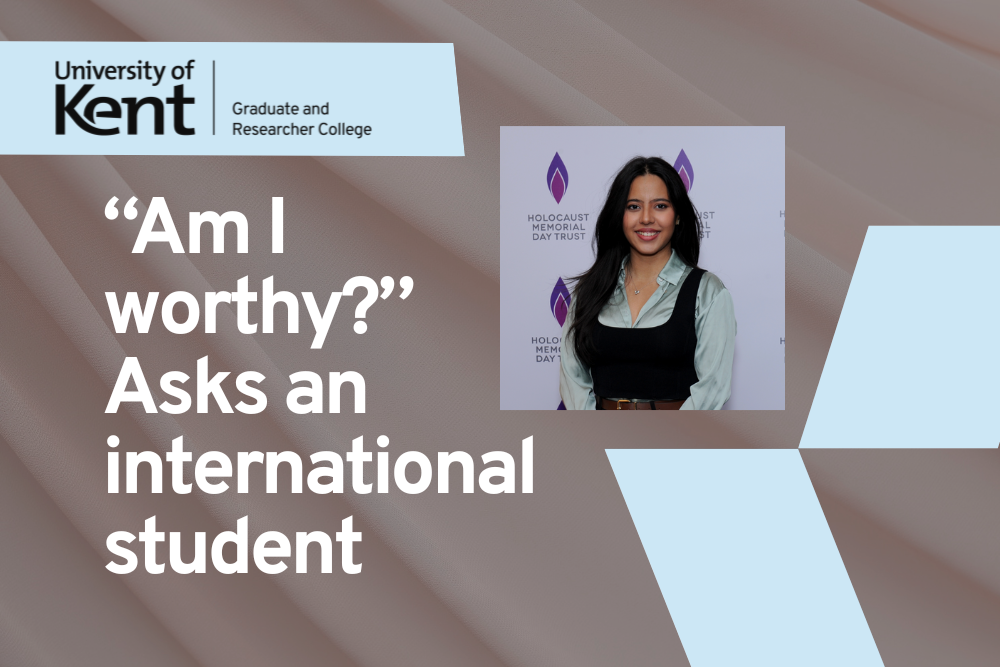
In this reflective and deeply personal piece, Nuzhat Tasnim Rahman Raisa, a first-year PhD student at the University of Kent, explores how ambition, academic prestige, and self-worth can become tightly entangled—especially for international students. Tracing her journey from growing up in Bangladesh to navigating rejection, imposter syndrome, and eventual acceptance into doctoral study, she unpacks the quiet pressures that shape how success is defined and internalised. “Am I worthy?” is a candid meditation on failure, resilience, and the slow, necessary work of learning to be kinder to oneself.
By the time I shared my aspiration with that lecturer, it felt almost inevitable, as though chasing an education abroad was simply the next logical step in proving that I was enough. I remember the way the lecturer looked at me – polite, but unconvinced. There was a pause before he spoke, but the gist of what he had said to me was that my ambition was too high, too unrealistic. I had mentioned the University of Cambridge, and he told me, almost matter-of-factly, that I wasn’t going to get in. I had gone to him for something simple: a reference letter, the kind everyone needs when applying for degrees abroad. I wasn’t expecting encouragement, but I wasn’t prepared for dismissal either.
His words landed quite heavily on me. I quickly started thinking of what he had said, the implication that I wasn’t enough, that my aspirations exceeded my worth. Knowing how deeply I
tied education to success, and success to self-value, I became hell-bent on proving him wrong. What had started as a dream now felt like a challenge, one I was determined to meet.
Truth is, I wasn’t ready to apply to the University of Cambridge. I did it anyway. I wasn’t prepared because my education back home hadn’t taught me how to think critically or question what I was given. It taught me how to fit in, how to repeat, and how to survive the system by being the same as everyone else. I don’t mean to imply that people from Bangladesh have never made it to Cambridge—many have, and brilliantly so. But I didn’t have what it took then, and because my sense of self-worth was so tightly bound to achievement, every acceptance or rejection felt like a judgment on who I was.
When I was admitted to the University of Edinburgh instead (prestigious, respected, a dream for many), I couldn’t let myself be happy. In my mind, it wasn’t enough, which meant I wasn’t enough. I carried that feeling with me into every lecture hall and library. I felt behind. My thoughts didn’t seem sharp enough, my writing felt clumsy, and everyone around me appeared more confident, more articulate, more prepared. My grades no longer mirrored those of my undergraduate years, so I assumed something in me had gone wrong.
I graduated with a Merit. Objectively, it was an achievement. Subjectively, it felt like a failure. I had grown up hearing from peers, from relatives, from society at large that it was either distinction or nothing. So, I left Edinburgh carrying a fear of falling behind, convinced that the degree, like me, wasn’t enough. The job market only reinforced that belief. I struggled to find work that I liked, and when I did, it felt underwhelming. That was when a stark realisation hit me hard: grades don’t matter in real life the way I had been taught they would. Still, even with some job experience, the struggle didn’t disappear. So, I pivoted towards learning new tangible skills, like project management and built a career in non-profits and fundraising, and stayed there for two years.
And yet, when the thought of returning to academia surfaced, the old voices came back. Not smart enough, not original enough, not enough. Imposter syndrome had learned my language well and whispered it back to me convincingly. I was getting rejections, further pushing me to believe these whispers. Then, one day, someone I worked with said something that made me rethink, “Let no one ever make you feel that you don’t belong in this space”. It stayed with me.
I asked for help. I went out of my way to network, connect with other people, and learn how to truly make my ideas more unique. It worked. I got my first acceptance in January last year from the University of Bradford, followed by the University of Kent in February 2025. I wasn’t going to attach my self-worth to an institution again, or a vision, or what I thought success looked like. I prioritised my idea, my research, and faith in myself. I stumble even now. Every conference feels like a reminder that there are better researchers out there. Every presentation feels like a scrutiny.
But, for once, in many years, I am looking at the present and my past with more gratitude and patting myself on the back on days when it’s difficult to look at the positives. Truth is, I wasn’t trying to prove to others that I am worthy; I was trying to prove to myself, and I projected that in everything that I ever did. So, to every student at the University of Kent and beyond, if you’ve left your family, your comfort zone behind and are starting life anew in an environment that feels overwhelming, you’ve already done the hardest part.
It’s okay to feel like you’re not good enough some days, but remind yourself that you’re living a life that you only once dreamt of. For every person who academically excelled when young and was forced to be the best, it’s actually nice on the side of mediocrity. I like to think of it as the oil that keeps the machine of life running. If success is static, we won’t be able to appreciate all the hard work or the success itself. If we never taste defeat or disappointment, how will we ever learn to be the better versions of ourselves?
We are truly our worst critics, but as international students, I think it’s time we unlearn that. Kindness to others can only be extended if we are kind to ourselves.