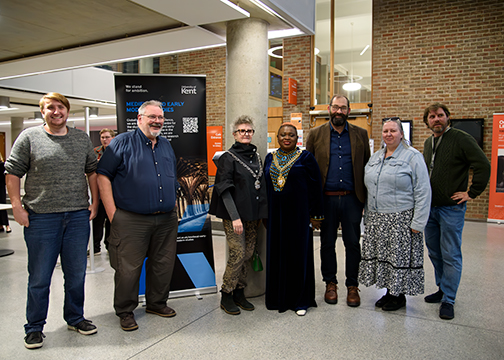
We started the year of events with Kent & Canterbury History and Heritage’s Michael Nightingale Memorial Lecture to which the Lord Mayor of Canterbury Cllr Keji Moses and the Lady Mayoress Mrs Carol Reed were able to attend as great supporters of history and heritage outreach events. This report below from Dr Sheila Sweetinburgh can also be found on the brilliant KCHH blog:
The audience of over forty people comprised the Lord and Lady Mayoress, trustees from both Brook Rural Museum and CAMEMS, staff from Kent MEMS, established and new Kent MEMS postgraduates, including those who have transferred from CCCU, and members of the public. Having opened the proceedings by welcoming everyone, it is good to be able to record that, Michael Byrne, Peter Joyce and Jason Mazzocchi have received funding from the Oxus Foundation for their doctoral studies in 2025/26, that Jane Richardson has received funding from the CKHH Ian Coulson Fund, that CAMEMS has provided a MA bursary at Kent for Tris Lopez Huicochea and that several Kent MEMS postgraduates are continuing to receive funding through CHASE and other academic avenues. Securing any funding for postgraduate research, especially for those studying part-time, is extremely challenging. Even though the university sector does provide some and Kent MEMS has been very successful in a highly competitive field, it does mean financial support from (charitable) organisations such as CAMEMS, Oxus, and the Coulson Fund is extraordinarily valuable in ensuring that high quality postgraduate research by students from diverse backgrounds and circumstances can continue.

I then called on John Nightingale, as chairman of Brook Rural Museum, to say something about his father Michael Nightingale, who was instrumental first as a student at Wye College in the 1940s and then in the months before his death, in bringing the Museum into being and then ensuring its long-term survival. For the wonderful collection of agricultural equipment, implements and tools from Kent’s horse-drawn era of farming needed a new home when it faced the threat of being broken up, and it again faced an uncertain future until the foundation of the Wye Rural Museum Trust with the collection housed in the magnificent late 14th-century aisled barn at Brook and the neighbouring early round oast house. These form part of a now highly unusual surviving manorial complex of barn, church and manor house. Moreover, as John said, the Trust and Museum have not stood still and in recent years have secured Heritage Lottery and other funding for a series of projects, which have heavily involved Philippa Mesiano among others, who successfully completed her PhD at Kent MEMS several years ago. For the Museum’s website, please see: https://brookruralmuseum.org.uk/
Taking this on board and the connections already between the Museum and Kent MEMS, as well as CAMEMS, and then bridging to this annual series of lectures previously held under the Centre for Kent History and Heritage at CCCU, it seems highly appropriate this year that the speaker was Victoria Stevens, a member of the Kent History Postgraduates group and, as already noted, a recent CCCU Masters graduate. Consequently, it gave me great pleasure to introduce Victoria who has worked in heritage collections for about 30 years and amongst other posts, is currently the Subject Lead for Books and Library Materials at the prestigious West Dean College, a nationally leading educational establishment in conservation and restoration in a wide range of fields. Thus, her title was supremely appropriate for the lecture being ‘Conserving Intangibility: the significance of change in heritage collections’.

Victoria began by saying that she has a love-hate relationship with library and archive conservation and she explored why she feels this way and why it matters that conservators, while potentially seeking invisibility for their work, need to realise and in a sense acknowledge that the less than perfect is part of that building, object or other thing’s journey. She illustrated this potential conundrum by showing us iconic buildings such as the Leaning Tower of Pisa and then different approaches taken in respect of what to do about war damage at Ypres Cloth Hall after WWI and Coventry Cathedral after WWII. Developing this thought-provoking approach, she next asked her audience to consider which they thought was more appropriate – restoration or conservation, with potential grey areas between these poles – illustrating this with a 1895 horse-drawn Bristol tram where one side has been restored to how it would have looked when new and the other side stabilised but looking as it did when it was discovered. Continuing in some ways this theme, she explored the role of repair as part of the creation/production process of objects, providing ideas about how in some senses this can be seen as a palimpsest but also an integral part of that object’s early journey.

Having given us these ideas to mull over, Victoria explored 4 objects from what she sees as the Museum’s wonderful collection, which are well illustrated and discussed on the online catalogue (because of her busy schedule, Victoria hasn’t yet had a chance to visit the Museum in person). As she commented, in their carefully conserved condition each of these conjured for her the patterns of rural Kentish life where people made practical decisions about their tools and other objects, in terms of how to give them a long and productive life through individualistic repairs, as well as offering evidence of use and innovation. Her chosen objects were a hop scuppet, a grain scoop, a half-bushel shovel and a Windsor chair, which had been used by Mrs Rose Daveson, a hop picker. This was a fascinating insight into how a professional conservator and instructor envisages the best way to look after and display such objects, both for the sake of the object and what it can impart to a range of audiences, which is equally the purpose of a museum.
Victoria then considered conservation as a human response before giving us a few examples of how it is vital for the conservator to look very carefully at all aspects of an object because often it is only then that evidence of use becomes visible and understandable, vital aspects of that object’s journey of which conservation is only a part. Consequently, as a final comment Victoria said that the key words for her are caution, collaboration – asking others is well worthwhile, communication and acceptance, for at the end it is important to accept that for some parts of our heritage it is changeable and transitory.
This lecture drew highly appreciative applause and after a short Q&A session (plenty of people came over afterwards to ask questions), I asked John Manley, the treasurer of CAMEMS, to give a vote of thanks. If you would like to find out more about CAMEMS, please see the website: https://www.camems.org.uk/community/camems-20688/home/

Then having thanked all for coming and mentioned the retiring collection again, to be split between the Museum and CAMEMS, I drew the Nightingale Lecture 2025 to a close.