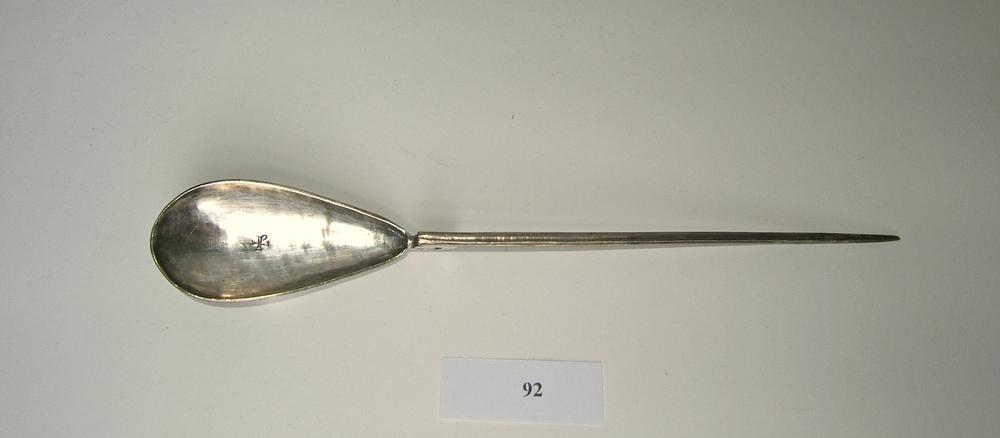
Silver spoon from Hoxne hoard with chi-rho © The Trustees of the British Museum. Shared under a Creative Commons Attribution-NonCommercial-ShareAlike 4.0 International (CC BY-NC-SA 4.0) licence.
In a previous blog post, we mentioned pagan religion in Britain and its survival into the fifth century. Alongside paganism, in this period Christianity was gradually becoming more widespread, and we also have evidence relating to it in our hoards dataset, as we noted in our post about the Canterbury hoard.

The most extensive evidence comes from the Hoxne hoard in the British Museum, which includes twenty-one objects with Christian symbols on them. Mostly these objects are items of dining equipment, such as the spoon shown above, but there is also a necklace implying its owner was a practising Christian. It is interesting that the motif is at the back of the necklace, where the clasp is, rather than being prominently positioned at the front. In everyday use, it was perhaps more a personal amulet for protection, than a display of faith to others. It’s interesting to consider how similar or different people’s Christian beliefs may have been to those of Christians today. In the early days of Christianity, it was a widespread belief that people would live to see, in their own lifetime, the end of the world and the return of Christ (in Christian belief the Son of God).