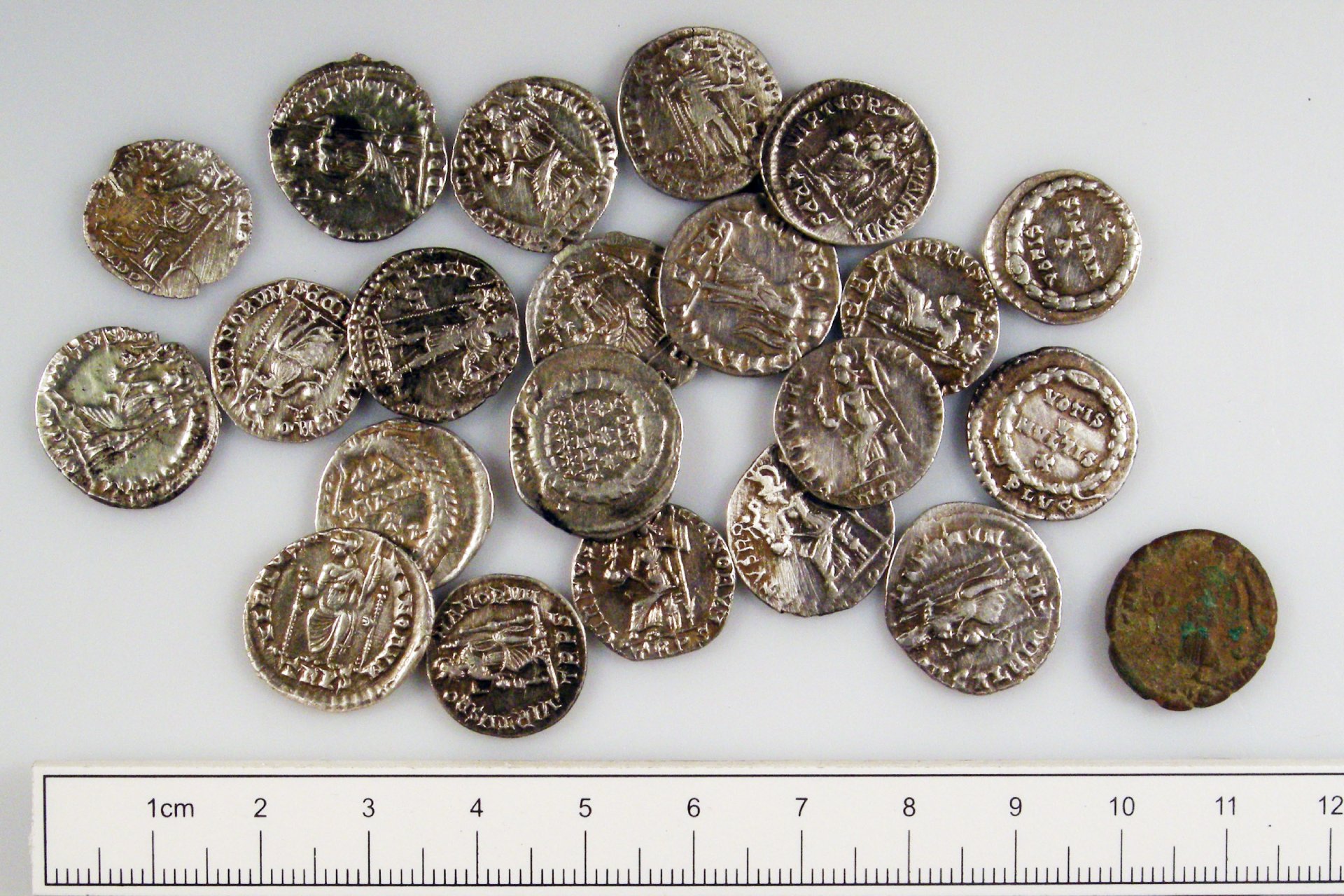
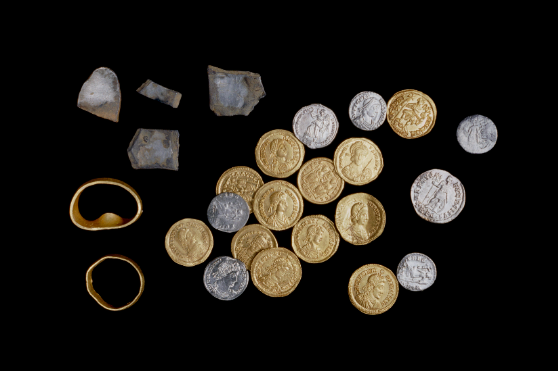
The Patching hoard from West Sussex is unlike any other late Roman hoard. It contains a mixture of 53 gold and silver coins, two gold rings, and over 50 pieces of hacksilver. But what makes it extremely unusual is that it contains both late Roman and post-Roman objects. Patching is fascinating because it marks the clear end point of the post-Roman to early medieval transition in Britain.
By the time the Patching hoard was buried, the coin-using economy had collapsed in post-Roman Britain. Instead, coins were valued as bullion. Alongside official late Roman issues, the hoard contains Visigothic coins struck in the middle of the fifth century. The official issues in the hoard are clipped and more worn whereas the fifth century continental issues are intact. Some scholars have suggested that the practice of clipping had ended by the time the hoard was buried but it is also possible that the Visigothic coins may not have entered circulation and been exposed to clipping.
The artefacts and hacksilver from the hoard were studied by Hunter and Rau (2025) and included fragments of ingots, vessels and personal equipment, as well as a complete scabbard chape – a protective metal tip mounted at the end of a sword scabbard. Their study showed that much of the silver had been reworked and recycled. In addition, many of the hacked fragments correspond to known Roman units of weight, providing valuable insight into the way the bullion economy operated. As we will explore in a future blog post, the recently discovered Wem hoard from Shropshire similarly sheds light on the nature of the bullion economy operating in Britain by the start of the sixth century.
The hoard is currently on display at Worthing Museum and Art Gallery. We are excited to revisit the Museum later this month to look at these objects first-hand and to deliver our interactive workshop to the public.