
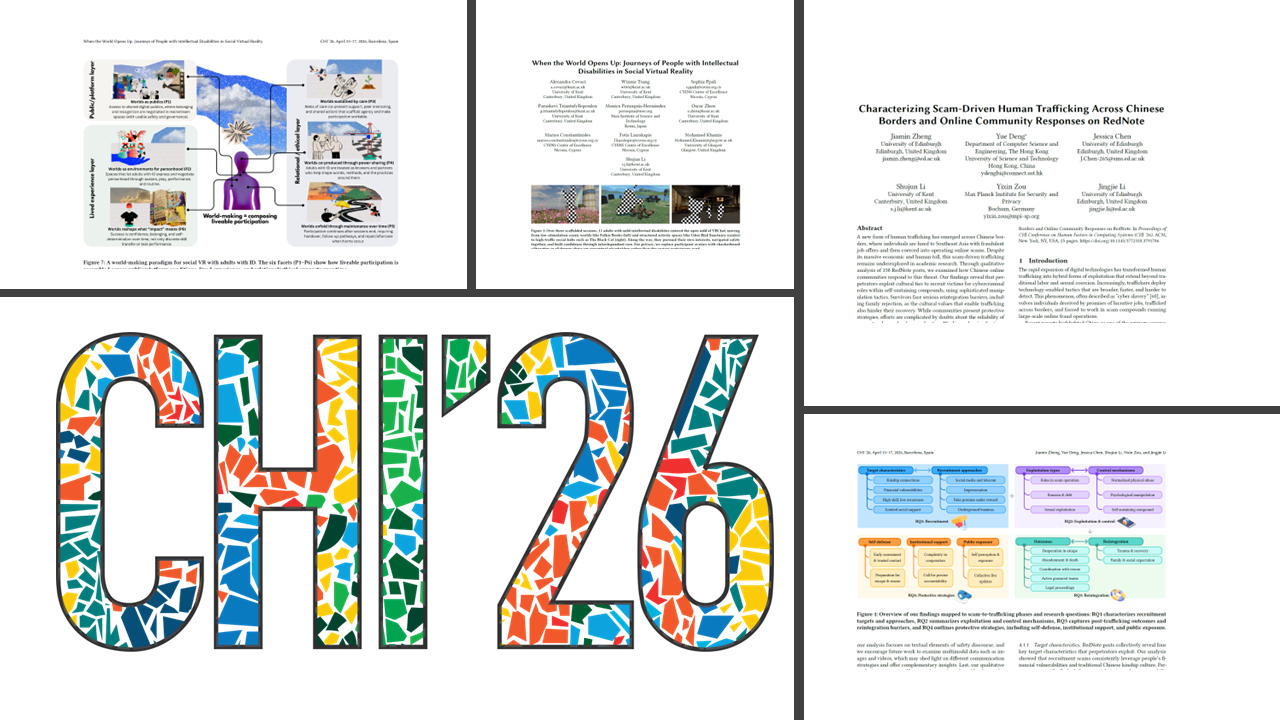
iCSS researchers Professor Shujun Li (iCSS Director and Core Member), Dr Alexandra Covaci (iCSS Research Collaboration Lead and Associate Member), Dr Oscar Zhou (iCSS Deputy Director (Interdisciplinarity) and Associate Member), Dr Chee Siang (Jim) Ang and Dr Paraskevi Triantafyllopoulou (iCSS Associate Members) at the University of Kent have co-authored the following five papers accepted to ACM CHI 2026, the top-tier conference on human-computer interface. Three of the accepted papers received an award from the Conference’s Awards Committee selected. The awards were selected from 1,705 accepted papers, based on an approximate percentage of 6,730 completed submissions: 62 Best Paper Awards (top 1%) and 213 Honourable Mentions (top 5%).
- Characterizing Scam-Driven Human Trafficking Across Chinese Borders and Online Community Responses on RedNote (Best Paper)
Authors: Jiamin Zheng, Yue Deng, Jessica Chen, Shujun Li, Yixin Zou and Jingjie Li - When the World Opens Up: Journeys of People with Intellectual Disabilities in Social Virtual Reality (Honourable Mention)
Authors: Alexandra Covaci, Winnie Tsang, Sophia Ppali, Paraskevi Triantafyllopoulou, Monica Perusquia-Hernandez, Oscar Zhou, Fotis Liarokapis, Marios Constantinides, Mohamed Khamis and Shujun Li - Looking inside the VR Music Scene: Mapping Platforms, Events and People (Honourable Mention)
Authors: Sophia Ppali, Alberto Boem, Alexandra Covaci, Marios Constantinides, Fotis Liarokapis and Luca Turchet - Building Care That Fits Its People: Insights from Social-Media–Enabled Community-Based Rehabilitation in Thailand
Authors: Acarima Nanthanasit, Sophia Ppali, Wan-Jou She, Panote Siriaraya, Thammathip Piumsomboon, Siwaporn Sukittanon, Chee Siang Ang and Alexandra Covaci - “Words are not enough”: Examining Emotional Support by Conversational AI for Caregivers
Authors: Melika Vafafar, Sian Joel-Edgar, Casper Harteveld, Hossein Dabbagh, Andrew K. Martin and Chee Siang Ang
The first two (award-winning) papers are about online harm and online safety, an important research area for which iCSS researchers have been actively conducting research activities to help develop a better understanding of the problems and to inform better interventions. More details about the two papers are given below:
- Characterizing Scam-Driven Human Trafficking Across Chinese Borders and Online Community Responses on RedNote
Preprint available at https://doi.org/10.48550/arXiv.2603.26520
Abstract: A new form of human trafficking has emerged across Chinese borders, where individuals are lured to Southeast Asia with fraudulent job offers and then coerced into operating online scams. Despite its massive economic and human toll, this scam-driven trafficking remains underexplored in academic research. Through qualitative analysis of 158 RedNote posts, we examined how Chinese online communities respond to this threat. Our findings reveal that perpetrators exploit cultural ties to recruit victims for cybercriminal roles within self-sustaining compounds, using sophisticated manipulation tactics. Survivors face serious reintegration barriers, including family rejection, as the cultural values that enable trafficking also hinder their recovery. While communities present protective strategies, efforts are complicated by doubts about the reliability of support and cross-border coordination. We discuss key implications for prevention, platform governance, and international cooperation against scam-driven trafficking. - When the World Opens Up: Journeys of People with Intellectual Disabilities in Social Virtual Reality
Preprint available at https://kar.kent.ac.uk/113513/
Abstract: Adults with intellectual disabilities (ID) face systemic social exclusion that narrows autonomy and life opportunities. While social virtual reality (VR) offers a powerful medium for identity expression and community belonging, research often adopts a remedial paradigm, focusing on training functional skills in scripted environments. This paper challenges this deficit-based model by treating social VR as an open world for participation. Following 11 adults with ID across multi-session engagements with VRChat, we employed an adaptive, relational method to scaffold participant leadership. Findings reveal that participants used the platform for interest-driven discovery, sustained through interdependent care webs. Crucially, the study demonstrates how social VR supports transferable confidence and emerging digital citizenship, enabling some users to transition from novices to community leaders. We contribute six Disability Justice-aligned design principles articulating a world-making paradigm that reorients Human-Computer Interaction toward supporting personhood and self-determination in mainstream digital publics.
Both papers are results of collaborations with external and international researchers. The first paper was led by researchers from the University of Edinburgh in the UK and involved researchers from the Max Planck Institute for Security and Privacy in Germany, and the Hong Kong University of Science and Technology in China, in addition to the iCSS researcher Professor Shujun Li. Led by the iCSS researcher Dr Alexander Covaci, the second paper involved researchers from the University of Glasgow in the UK, the CYENS Centre of Excellence in Cyprus, and the Nara Institute of Science and Technology in Japan, in addition to four other contributing researchers from the University of Kent (Winnie Tsang, Dr Paraskevi Triantafyllopoulou, Dr Oscar Zhou and Professor Shujun Li). The work of the second paper was part of the research project “SaferVR: Investigating the Opportunities and Risks of Social Virtual Reality for Adults with Intellectual Disabilities”, which was funded by the UKRI (UK Research and Innovation) via the 2024 Strategic Funding call of the REPHRAIN (National Research Centre on Privacy, Harm Reduction and Adversarial Influence Online).
All the papers will be presented at ACM CHI 2026 in Barcelona, Spain from 13 to 17 April 2026. Congratulations to all the iCSS researchers and their collaborators and hope their work will help enable more future research work and inspire other researchers!