

Our degree outcomes have moved in the right direction. The distance between Black and White graduates still calls for action.
TEF, BAME, “TEF BLACK”
The Teaching Excellence Framework (TEF) is the Office for Students’(OfS) national assessment of undergraduate learning experiences and outcomes. It gives universities Bronze, Silver or Gold ratings. University of Kent (Kent) received Silver overall for both undergraduate student experience and student outcomes in 2023. That recognises strength across the university. Nonetheless, it masks the experience of Black students.
In order to understand the students this blog post refers to, we first need to unpack some terminology. The acronym BAME for more than two decades now stands for Black, Asian and Minority Ethnic. The label remains in Kent’s internal dashboard and even in an OfS glossary, although the regulator also asks providers to analyse individual ethnic groups rather than rely on an aggregate and OfS also individualise the APP target by ethnicity. BAME is not a homogeneous category; it encompasses ethnically diverse groups whose experiences, educational outcomes and encounters with institutional structures can differ substantially. Examining these groups separately reveals which inequalities become visible to policy and which are obscured by aggregation.
Throughout this blog, Black refers to students recorded in Kent’s Black ethnicity category: those who identify as Black African, Black Caribbean or from another Black background. Kent reports Mixed ethnicity separately, including students of White and Black African or White and Black Caribbean heritage. These are categories for monitoring outcomes; they do not imply that all Black students have the same experiences, or capture everyone who may identify as Black. Using Kent’s category allows this article to focus on the specific Black/White degree awarding gap in the university’s access and participation plan. Black identifies the students whose outcomes are the focus. This distinction makes the Black awarding gap visible and directs attention to the university practices that may shape it.
At NERUPI’s conference on degree awarding gaps on 18 May 2026, Dr Josephine Gabi of Manchester Metropolitan University and I presented our paper entitled “TEF Black: (Re-)defining Teaching “Excellence” as a Commitment to Educational Justice”. ‘TEF Black’ is a critical intervention into the OfS’s regulatory measurement of ‘teaching excellence’, asking what a designation of excellence can mean when racial disparities in degree awarding remain obscured by the institutional rating, what Black students encounter in learning and assessment, then ask how those experiences relate to the degrees they are awarded (Figure1). It brings the less comfortable evidence into the judgement and asks those who shape university systems to respond. TEF Black is our conceptual challenge; the OfS does not issue a rating by that name. Its next question is about the denominator: whose learning and success can be seen in the evidence used to make that claim? We, therefore, name Black students deliberately since the aggregate term “BAME” can conceal distinct outcomes.
What “TEF Black” looks like at Kent
In 2025-26 Kent’s EDI report counted 3,410 Black students, 20.3 per cent of its reported student population. Their experience belongs at the centre of any account of teaching excellence. Kent APP set a Black/White first-or-2:1 awarding-gap baseline of 19.1 percentage points in 2021-22, with a 10-point milestone for 2027-28. The plan reports that this gap was 26.9 points in 2018-19 and 14.9 points in 2020-21 before rising again. Kent’s 2024-25 transparency return shows 62.8 per cent of Black and 84.2 per cent of White qualifiers with classified first degrees receiving a first or 2:1: a 21.4-point difference. It was the largest of the broad ethnicity gaps shown in that return.
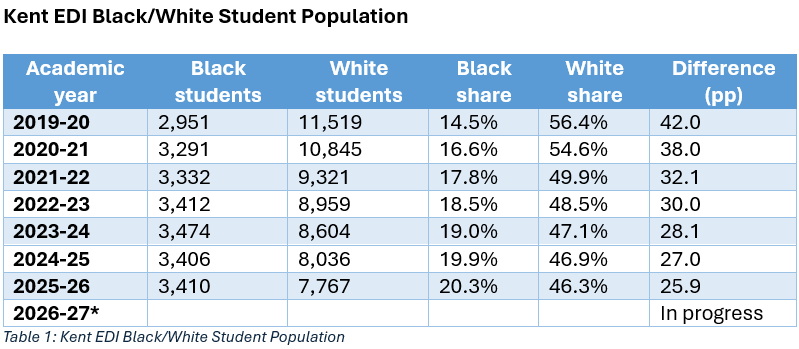
Table 1 shows that the difference between Black and White students’ shares of Kent’s enrolments narrowed from 42.0 percentage points in 2019-20 to 25.9 points in 2025-26. Black students accounted for 20.3 per cent of all students in 2025-26. At that scale, TEF Black asks what happens after access: how do Black students experience teaching and assessment, and what do their degree outcomes reveal about Kent’s claim to excellence?
Way Forward
TEF looks at whether students continue, complete and progress after study. But degree classification sits outside its core outcome indicators. TEF Black urges us examine what happens between those milestones, particularly for Black students. Are the standards for excellent work made clear before submission? Does feedback help students use the next opportunity? When course results differ by ethnicity, who examines assessment practice and has the authority to change it?
Kent 2030 pledges to support success for all; our access and participation plan aims to eliminate ethnicity attainment gaps. Kent’s Curriculum and Educational Development Team already supports course redesign, the new Assessment and Feedback Policy and work to reduce racial awarding gaps.
What can you do?
- Schools should continue to examine course-level patterns by ethnicity where the numbers permit, revise assessment when disparities persist, and tell students what changed.
- University leaders ensure that academics are given sufficient time to review assessment briefs, to mark and feedback to students
- Professional services (i.e. Library, student experience, student well-being, careers and employability) follow the changes through to outcomes; report what helped and what needs another approach.
- Individual lecturers be inclusive in your assessment and teaching practices.
By the next TEF assessment, what will a Black student be able to say has changed at Kent?
Blog by Dr Yetunde Kolajo @ y.kolajo@kent.ac.uk