
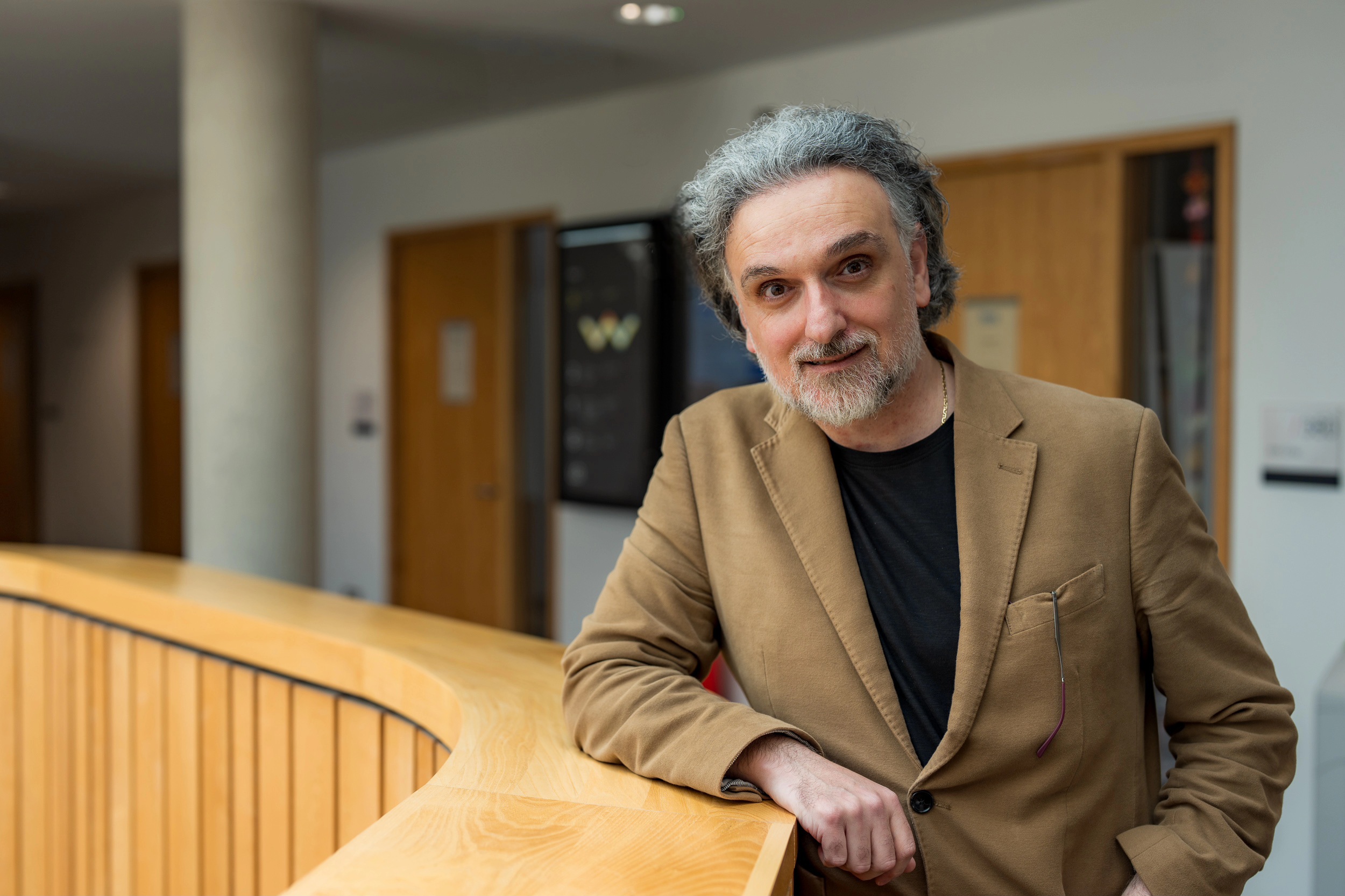
Our next staff Kent Diamond is George Saridakis. George is a highly distinguished academic, whose research focuses on firms and the wider economy. He is also a renowned researcher and mentor. Hear from George:
“I am George Saridakis, an applied economist whose research focuses on firms and the wider economy, including the survival and growth of small and medium-sized enterprises, entrepreneurship and innovation, internationalisation and trade, the use of technology, and illicit activity.
My research primarily draws on time-series, panel, and cross-sectional data, and has led to numerous academic publications, edited volumes, book chapters, and reports. I mainly teach entrepreneurship and small business-related subjects, although I have also taught across other areas of economics.
I am particularly interested in how economic behaviour reflects broader questions concerning the creation of opportunities for start-ups, growth, expansion and trade; the stimulation of innovation and performance; the reduction of inequality and other social challenges; and the shaping of decision-making, particularly in the small business sector and across different stages of economic development.
At the heart of my work lies a commitment to learning and intellectual curiosity, alongside a belief that research and teaching are not only about generating knowledge, but also about sharing understanding and collectively making sense of the world.
Outside academia, I enjoy a range of activities, including reading, particularly philosophy and history, practising Shotokan karate, and playing musical instruments, mainly the guitar and the Cretan lyra. I also value spending time with my family and loved ones, especially my daughter.”
Tell us about your role at Kent and how you make an impact.
“Since joining Kent Business School, I have been actively engaged in research, teaching and leadership. Over this period, I have had the privilege of working with colleagues, students, practitioners, businesses and other stakeholders, whose engagement has made my academic work both meaningful and rewarding.
Through these relationships, I have been able to observe the practical impact of my work. In particular, seeing students make strong progress and recognising the value of my modules and research have been among the most rewarding aspects of my role. Equally, working with research students and early-career academics, and observing their development into skilled, independent and ethical researchers, has been highly fulfilling.
My research, often conducted in collaboration with colleagues, seeks to contribute to theory, practice and policy. Engagement with policymakers, businesses and funding bodies, alongside academic collaboration, has helped to ensure that this work informs decision-making and achieves practical impact. Some of this research has been featured in a range of media outlets, included in major reports, and cited by leading policy and institutional bodies.
Moreover, building strong international links and collaborating with exceptional researchers from various parts of the world, including the University of Sharjah, the University of the West Indies, the National Autonomous University of Mexico, York University and the University of Minho, as well as engaging with the International Entrepreneurship Forum, the Academy of Management and the Institute for Small Business and Entrepreneurship, ensures that research is shared across borders and promotes inclusivity and collective endeavour.
Within my leadership roles, I have also sought to serve the wider academic community, support collective goals and contribute to the institution’s shared mission. As a former Head of Department, I placed particular emphasis on maintaining a balance between wellbeing and departmental performance. My approach has been to serve both students and staff as ends in themselves, while representing the best interests of the department as a collective entity.
Ultimately, however, the impact of my work as an academic and educator can only be assessed over time by individuals, societies and economies. My role is not to measure that impact directly, but to pursue my work with integrity, humility and to the best of my ability, trusting that its contributions may become fully visible only in the longer term.”
Tell us about how you mentor students and early-career academics.
“Mentoring students and early-career academics is a central part of my academic role. They represent the future of the discipline and, through their work and engagement, contribute to the evolution of knowledge across generations.
In these relationships, knowledge and experience flow in both directions, creating a dynamic and continually evolving process of learning. I place strong emphasis on respect, intellectual curiosity and critical questioning, as well as on supporting students’ development with genuine commitment and a passion for finding out. I also believe that progress in research and academia is rarely linear, and that learning often comes through challenge, persistence and reflection. In this sense, knowledge is not only an outcome but also a process of formation, a beautiful journey, as Cavafy reminds us, that should not be rushed.
Over the years, I have worked with many talented students and early-career academics, of whom I am very proud. At Kent, I have supervised research students who have conducted excellent work on internationalisation, self-employment, business model innovation, the sharing economy, and aspects of small businesses. I have also worked with exceptional research students during my time in previous institutions, across topics such as ethnic minority entrepreneurship, wellbeing and career pathways, and information security. I have maintained strong relationships with my former research students, and the mutual respect and appreciation developed over the years have given me great fulfilment and confidence that these early-career academics will make a significant contribution to education and society. I currently also work with several early-career academics within my School, and this collaboration has been deeply rewarding, not only through the exchange of knowledge, skills and ideas, but also through the development of strong friendships and long-term professional bonds.
My work also extends beyond the United Kingdom through my visiting and honorary roles. In my role as an Honorary Professor at the University of the West Indies, for example, I collaborate with both emerging and established researchers. This work has contributed to research on trade in the Caribbean, with colleagues producing impactful publications and progressing into strong professional roles. Working with the Sir Arthur Lewis Institute of Social and Economic Studies and the Department of Economics has been particularly rewarding, and the staff and research students there exemplify leadership, hard work, commitment and respect. It has been a privilege to work with individuals of such quality and commitment.”

What are some of your favourite things about the University?
“One of my favourite aspects of the University of Kent is its people, both colleagues and students. In particular, my colleagues in Marketing, Entrepreneurship and International Business, which I led for several years, have been central to my experience. This includes both current colleagues and those who have moved on but remain closely connected to the department. They are not only excellent scholars but also remarkable individuals. Their support has been invaluable, and the mutual respect we have built is both strong and enduring. I would like to take this opportunity to thank them for navigating challenges together and sharing successes as a team.
Similarly, my research students, both current and former, have brought great energy, intellectual curiosity and enthusiasm for learning, as well as a meaningful exchange of ideas that has made my research and scholarly activity at Kent particularly memorable. It is equally rewarding to engage with MBA and undergraduate students, and to share the classroom experience while exploring entrepreneurship, small firms and broader economic questions.
Above all, what I value most is the human dimension of the University. I believe this human element forms the foundation of a university as an institution of paideia, where knowledge is not only transmitted but also formed through shared intellectual and human experience, a dimension that should not be lost as modern technological approaches become increasingly embedded in education.”
Who helps make the Kent community special for you?
“What makes a community strong is meaningful interaction, openness to pluralism, creativity, mutual support, and a shared commitment to trust, respect and the common good.
During my time at Kent, I have experienced all of these through my interactions with colleagues, academics, professional services staff, and both early-career and established researchers, as well as individuals and working groups. Within the group in Marketing, Entrepreneurship and International Business, with which I am very familiar, these qualities have always been strongly present, and it was a great honour to have served as Head of this exceptional group, which is highly committed to research and teaching.
I have also had the opportunity to work with colleagues from various other disciplines and schools, for whose support, collegiality and openness I am very grateful. Professional services staff have also played an important role, consistently offering generous support and assistance. Finally, our students are central to our community, as they are the ambassadors of our University and of the work we carry out here.
It is difficult to fully capture the depth of support, collegiality and intellectual engagement that exists within these relationships. Collectively, these individuals make the Kent community special, not only for me, but for anyone who is part of, or visits, the University.”
What advice would you give to current Kent students?
“My advice to students is to:
- Make the most of their time at university by engaging deeply in learning, cultivating understanding and developing knowledge.
- Always question, for it is through questioning that deeper understanding emerges and new knowledge is created.
- Make full use of the rich intellectual environment, human capital and resources that the University provides.
- View your degree not only as preparation for employment, but as a formative journey of personal and intellectual growth; everything else will follow from this foundation.
- Work diligently and act with integrity, recognising that knowledge is a form of capital that endures throughout life.
- Be proud of taking the step to enter university, and upon graduating, be proud to say that you studied at the University of Kent.
Finally, remember those who generously share their knowledge and experience with you, as each of them has laid a small stone along the path of who you will become, and you too can do the same for others in the future.
Much of this advice I have learned through my own experience and reading, as well as through interactions with important researchers and individuals such as the late Professor David Storey, and I hope you find it useful.”
The Kent Diamonds campaign recognises the students, staff and alumni that make Kent shine. Learn more about our Kent Diamonds and our other 60th Diamond Anniversary celebrations.