
About Stephen Gray
Stephen Gray (1666-1736) was a dyer and amateur scientist from Canterbury. He made contributions to various fields including astronomy, palaeontology, biology and optics but is best known for his discovery, in the 1720’s, that some materials can conduct electricity while others act as insulators. In 1729 he managed for the first time to transmit electricity over long distances working with his friend the Reverend Granville Wheler (at the latter’s estate Otterden Place, near Lenham). He is also credited with the discovery of electrostatic induction as well as advances in solar astronomy and microscopy, among others. He experienced many difficulties, not least ill health due to his physically demanding job and poverty – a great handicap at a time when scientific research was mostly a sophisticated pastime for the rich. In spite of his great contributions to Science, Gray’s recognition only came late in his life: he was the first recipient of the Copley Medal in 1731 and became a Fellow of the Royal Society in 1733.
The Stephen Gray Lectures were instituted by the School of Physical Sciences on the University Kent’s main campus, in Canterbury to celebrate one of the region’s most prominent Physical Scientists. They were originally proposed by Jorge Quintanilla, who has been the organiser of the series, and have continued to be supported by the University of Kent and, since 2025/26, by the Institute of Physics London & South East Branch.
Selected Bibliography
General
For a general, very brief introduction to the figure of Stephen Gray, see:
- David R Lewis. “STEPHEN GRAY (1666-1736) Canterbury Dyer and Amateur Scientist.” CANTERBURY HISTORICAL & ARCHAEOLOGICAL SOCIETY (CHAS), 2015. https://www.canterbury-archaeology.org.uk/wp-content/uploads/2022/06/GRAY-RES-rev-1.pdf
The above work is written very much with a Canterbury perspective in mind, but constitutes an excellent starting point.
A thoroughly enjoyable account of Stephen Gray’s life and works set in the broader context of late XVII / early XVIII century science is offered in the following book:
- David H. Clark and Stephen P.H. Clark. “Newton’s Tyranny : The Suppressed Scientific Discoveries of Stephen Gray and John Flamsteed in SearchWorks.” New York : W.H. Freeman and Co., c2001. Accessed February 1, 2017. https://searchworks.stanford.edu/view/4487840.
The book was co-authored by David H Clark, our first Stephen Gray lecturer. You can watch a video of his lecture here.
The above book was reviewed by Mark P. Silverman in American Journal of Physics 71, 507 (2003), https://doi.org/10.1119/1.1561274 (also available at http://www.trincoll.edu/~silverma/reviews_commentary/newtons_tyranny.html, accessed 4 July 2018) and by M. Peck in Journal of Guidance, Control, and Dynamics 27, 734-735 (2004), https://doi.org/10.2514/1.11197.
The following web page contains a useful chronology and data sheet on Stephen Gray:
- “The Galileo Project: Stephen Gray.” Accessed October 21, 2016. http://galileo.rice.edu/Catalog/NewFiles/gray.html.
Here are some additional, quite detailed biographical articles on Stephen Gray:
- “Stephen Gray: The First Copley Medallist.” Nature, February 22, 1936.
- Cohen, I. Bernard. “Neglected Sources for the Life of Stephen Gray (1666 or 1667-1736).” Isis 45, no. 1 (May 1, 1954): 41–50. https://doi.org/10.1086/348285.
- Clark, David H., and Lesley Murdin. “The Enigma of Stephen Gray Astronomer and Scientist (1666–1736).” Vistas in Astronomy 23 (1979): 351–404. https://doi.org/doi:10.1016/0083-6656(79)90018-7.
- Sergio Luiz Bragatto Boss, and Joao Jose Caluzi. “Uma Breve Biografia de Stephen Gray (1666-1736).” Revista Brasileira de Ensino de Fisica 32, no. 1 (2010): 1602.
Electrical experiments
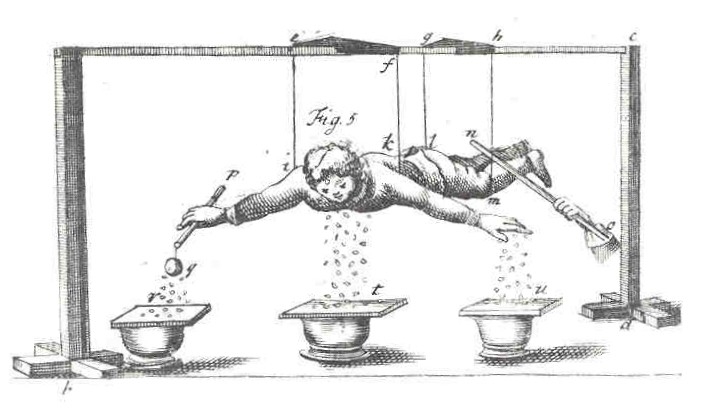
Jim Al-Khalili produced an excellent series of short, entertaining TV programmes on electricity for the BBC. His re-enactment of the famous Stephen Gray “Flying Boy” experiment is really worth watching:
- Jim Al-Khalili, “Stephen Gray’s ‘Hanging Boy’ Experiment” (video), in “Shock and Awe: The Story of Electricity”, British Broadcasting Corporation, https://www.bbc.co.uk/programmes/p00ksnyn (accesed 4 July 2018).
You can read more about the above experiment here:
- “The Flying Boy Experiment Entertained Audiences By Electrifying a Kid.” Accessed March 7, 2017. http://io9.gizmodo.com/the-flying-boy-experiment-entertained-audiences-by-elec-1679627835.
The following articles cover Stephen Gray’s electricity work, particularly his experiments on electrical conduction and insulation, more broadly:
- W. A. Atherton. “Pioneers – 1. Stephen Gray (c. 1666-1736): Discoverer of Electrical Conduction.” Electronics & Wireless World, n.d. http://hccc.org.uk/pioneers-1-grey.pdf
- John Jenkins. “Conduction, Insulation and Electric Current – 1729.” SPARKMUSEUM. Accessed March 10, 2017. http://www.sparkmuseum.com/BOOK_GRAY.HTM.
- “HI 322 at NCSU: Electrical Experiments.” Accessed February 1, 2017. http://www4.ncsu.edu/~kimler/hi322/electric.html.
Here is an interesting proposition to use Stephen Gray’s conduction experiments for project-based teaching:
- Andreas Henke and Dietmar Höttecke, “Stephen Gray – Electrical Conduction on the Wrong Track – Hipstwiki.” History and Philosophy in Science Teaching. Accessed January 17, 2017. http://hipstwiki.wikifoundry.com/page/Stephen+Gray+-+Electrical+Conduction+on+the+wrong+track.
Granville Wheler and Otterden Place
Otterden Place was the stately home of Gray’s collaborator, Granville Wheler, where the historic experiments on electrical conduction were carried out. The following page describes the place (with only a brief mention of the historic experiments):
- “Otterden Place, Kent & Ledston Hall, Yorkshire.” Handed On (blog), October 4, 2012. Accessed March 28, 2017. https://handedon.wordpress.com/2012/10/04/otterden-place-kent-ledston-hall-yorkshire/.
The following post focuses more specifically on the significance of the site for the history of science. It was written by Charlotte Sleigh, who is the Director of Kent’s Centre for the History of the Sciences, following a visit to the site on the occasion of the first Stephen Gray Lecture:
- Sleigh, Charlotte. “Otterden Place, Faversham, Kent.” The British Society for the History of Science (BSHS) (blog). Accessed July 25, 2017. http://www.bshs.org.uk/otterden-place-faversham-kent.