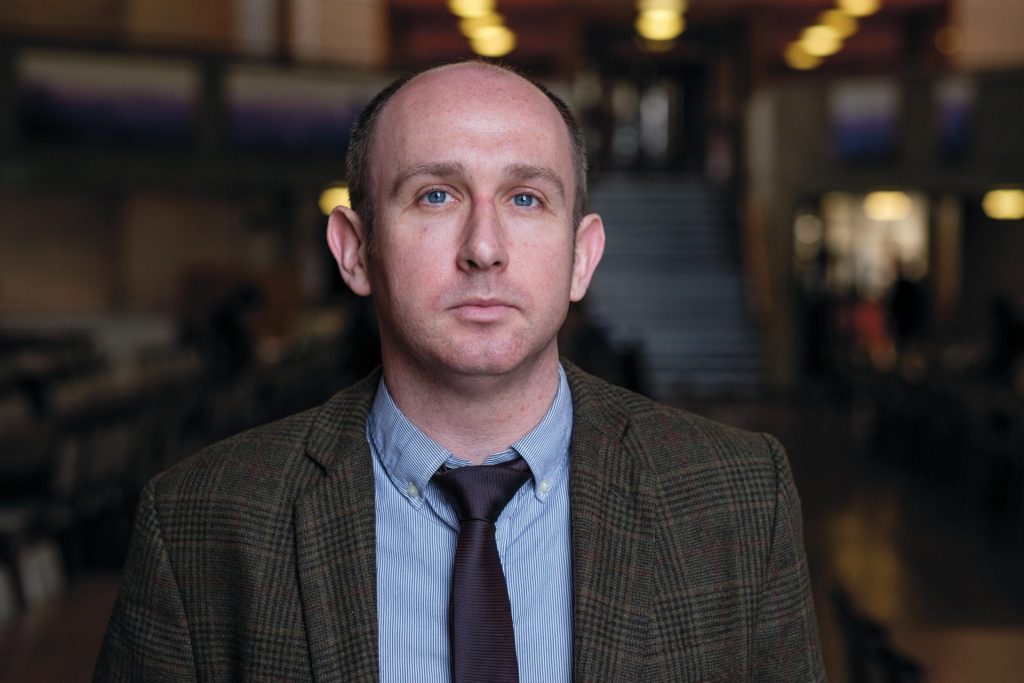
Dr Rory Loughnane, a Reader in Early Modern Studies in the School of Humanities, has confirmed ‘beyond any reasonable doubt’ that William Shakespeare was the principle writer of Edward III, and that it was written in collaboration with so-called rival and Canterbury’s most famous poet and playwright, Christopher Marlowe.
Up until now, Shakespeare’s contribution to the play, published anonymously in 1596, has been unsettled.
Working with Brett Greatley-Hirsch, Professor of Renaissance Literature and Textual Studies at the University of Leeds, he has since used computerised textual analysis to compare Edward III with securely attributed works by 10 dramatists active between the late 1580s and the mid-1590s. In one test, 23 segments were identified as being written by Shakespeare, while nine segments were classified as Marlowe – conclusive evidence that Shakespeare was the main author collaborating with Marlowe.
These findings are particularly significant because, as Dr Loughnane explained to The Guardian: “We have become accustomed to thinking of Marlowe and Shakespeare as rivals – two outstanding authors, born within a few weeks of one another, making their names in the same theatrical world of the late 1580s and early 1590s. But we now know that their relationship was much more complicated than that. They were not simply rivals or influences on one another.”
Together with a 2016 study which found that Marlowe was a co-author of Shakespeare’s three Henry VI plays, “their collaboration on Edward III in 1592 suggests a more sustained writing relationship in their mid-to-late 20s.”
The research is supported by The Marlowe Project at the University of Kent, a series of events activities, digital projects and exhibitions exploring the literary, social, and cultural influences on the production of Christopher Marlowe’s works, the mediation of his writings in manuscript and print, and the ways in which the meaning and significance of his writings have developed since the sixteenth century. The Making of Marlowe exhibition, running at the Beaney House of Art & Knowledge in Canterbury until 22 November, was curated as part of this project.
The findings are due to be published in the winter issue of Shakespeare Quarterly and Dr Loughnane’s new book, Shakespeare at Thirty, published today.