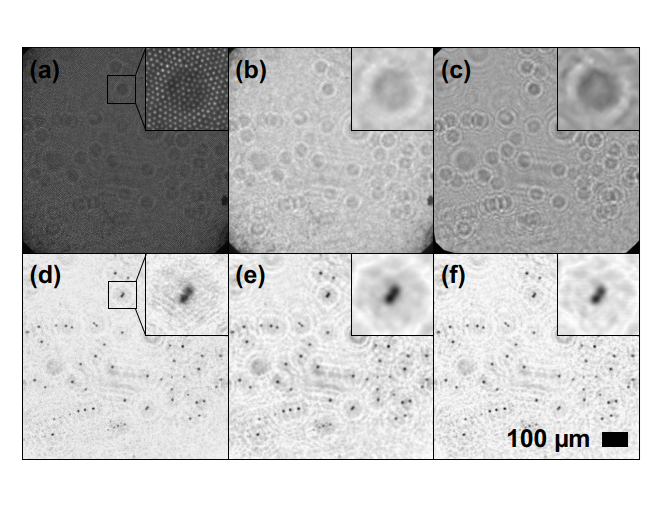
I have a new paper out in Applied Optics. This is a very unusual single-author paper – it’s something I’ve been working on whenever I find some spare time to get into the lab. It shows that it’s possible to do holographic microscopy using a fibre bundle, so you can put the camera a long way from whatever it is you are looking at.
The particular type of holographic microscopy is ‘inline’ holographic microscopy. In inline holography we don’t have any beam splitters to make a reference path. We send collimated or diverging light onto the sample, and then rely on interference between scattered and unscattered light to create the interference pattern on the camera or bundle – the hologram. We can then numerically refocus this hologram to produce a microscopy image at different distances from the camera/bundle. So, we can do microscopy without a lens, and without having to decide on where we want the focus to be in advance.
Inline holography has been around for quite a while, and has had some renewed interest recently because of improvements in computing power and machine learning which allows a lot more useful information to be got out. But it is always done by forming this hologram directly on a camera. I wondered if we could collect the hologram with a fibre bundle instead, and still be able to do the refocusing.
As you’d expect there are few drawbacks with this, mostly because the fibre bundle is pixelated which limits the resolution. The other big factor is that I could only get this to work using an LED, and not a laser. While using an LED is nice in some ways (no pesky laser safety forms to sign, for one!) because it’s not very coherent it makes it harder to get an interference pattern. By coupling the LED into a small-core fibre first we can get just enough spatial coherence to get a hologram, providing the sample is within a couple of millimetres of the bundle. So, we don’t have the long imaging range of laser-based inline holography set-ups.
The paper is in Applied Optics here, or if you don’t have access the pre-print is on Arxiv. All the data and code (Matlab) is on figshare here if you’d like to have a play yourself.
This was done purely speculatively, to see if it could be done, but I’m now trying to figure out if there are some useful applications. I have a few ideas I’m looking into, but if you have suggestions please get in touch.