There is a fabulous initiative at the University of Kent called the ‘Kent Physics Centre’, a series of monthly (ish) evening talks covering all aspects of physics and astronomy. The talks aren’t the usual physics seminar, instead they are at a level suitable for the general public (or at least the segment of it that might be tempted by such a thing!). It attracts people from across the University as well as the wider Canterbury community, and is supported financially by the Institute of Physics.
The Centre ran for many years under the stewardship of Dr Cyril Isenberg, a former faculty member at Kent. After a brief hiatus beginning in 2018, it was rekindled in 2023 by one of my applied optics group colleagues Dr Manuel Marques, and Dr Sam Carr, a theoretical physicist at Kent. Since then, they’ve had a fantastic line-up of speakers, mostly from other universities in the UK, but with the occasional current or emeritus academic from Kent.
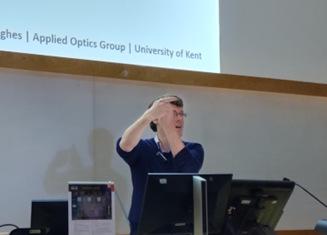
Not so long ago, Sam and Manuel risked lowering the bar substantially by asking me if I would give the November talk, which I happily accepted.
I naturally chose to focus on some of my own research, even though it would be a stretch to say most of what I do is ‘physics’, at least not in the popular sense of the word. I decided on a general talk about the problem of imaging (and particularly microscopy) through optical fibres. This topic has enough physics in it that I hoped it would interest regular attendees of a physics lecture series, but was also a chance to share some of the appeals of interdisciplinary research. In fact my opening pitch to any undergraduates in the audience (I spotted a few of my own academic advisees) was that microscopy and imaging are just as exciting topics for a developing physicist to think about as cosmology or quantum computers. I’m not sure if the argument was accepted, but I continued nonetheless.
As an experimentalist, I naturally had to include some live demos in the talk. The simplest thing to do was to bring along some fibres, and so I brought a 1 mm diameter fibre bundle and a 120 micrometer diameter multimode fibre, as examples of exactly what it is that we would like to send our images along. The multimode fibre was, of course, entirely invisible to the audience, which was arguably the point.
A big part of the talk was on holographic imaging through fibre, so for a more interesting demo I decided on an inline holographic microscope that could be used to show live images during the lecture. As we have several set up in the lab, that seemed simple enough to deliver. Unfortunately, other commitments meant that preparations were somewhat last minute and involved soldering cables barely a couple of hours before the talk to make something that was portable and a low enough laser power to be safe to bring into a lecture theatre. But in the end it worked well, and was a nice chance to show off our CAS software interface and the (soon to be released) HoloSnake GUI for holographic microscopy.
Last minute preparations aside, I think the talk went well, there were lots of questions and some enjoyable conversations over food afterwards in the University pizza bar, Hut8. I also had a few nice emails afterwards from people saying they enjoyed it. And, for anyone who would like a less engineering-focused talk, it looks like normal service will be resumed with a talk on ‘growing’ quantum computers in December.