Clara Chamberlain, PhD student at UEA, reports on the latest outing of Bookscapes, a set of workshops funded by UEA, with MEMS as the lead organiser. For this particular event which took place on 16th July, the organisers were Drs Sophie Butler, Tom Roebuck and Will Rossiter (all at UEA), with the visits facilitated by Gudrun Warren (Norwich Cathedral Library) and Chris Tracy (Norfolk Heritage Centre), to whom warm thanks are due.
Norwich Cathedral Library: Morning Session
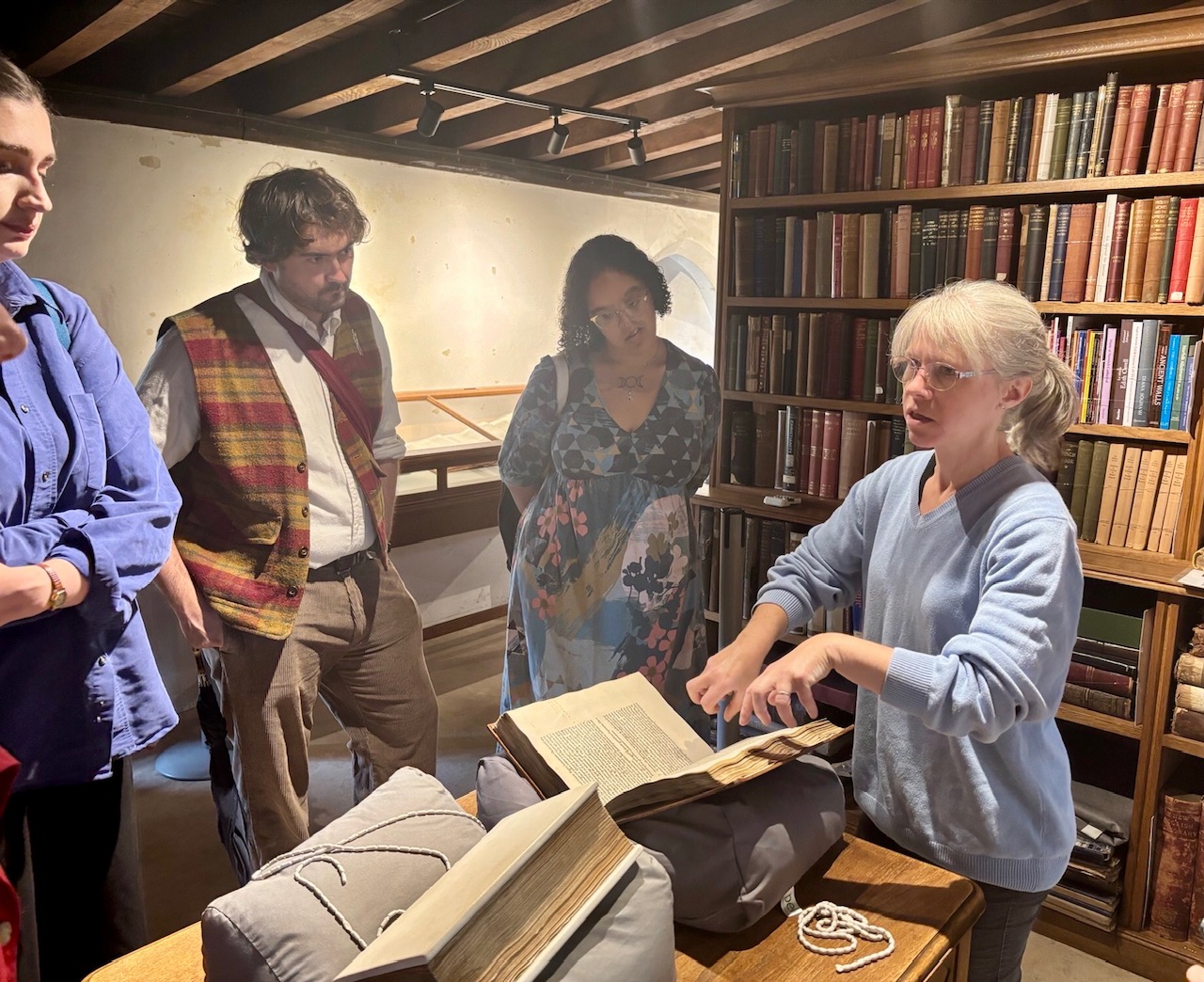
The Norwich Bookscapes session began in the Norwich Cathedral Library, with librarian Gudrun introducing the group to the history of the library at the Cathedral and the challenges faced by the collection over time in terms of environmental and socio-political crises – e.g. the manuscript collections being dispersed at the time of the Reformation.
Working with the Cathedral’s collection of early print, Will facilitated a conversation about how early printed books made for different purposes in different regions could show up physically differently on the page. The Lactantius’ use of a typeface modelled on the Italian humanist hand provided an interesting contrast to another book use of different print styles and the inclusion of several typefaces on a single page might serve to enhance the status of the printer and market certain works for specific audiences.
Our visit to the library also gave the group the opportunity to see an incredible example of recent conservation work. We were shown a photo of the collection’s copy of Foxe’s Book of Martyrs pre-conservation and then were able to observe how the damaged pages had been repaired and conserved by examining the book in its new binding.
A recurrent theme of the morning was the interplay of print and manuscript, from manuscript fragments in end-papers, including a rare medieval musical manuscript in a Nuremberg Chronicle’s pastedown, to handwritten parchment replacing printed pages in a well-thumbed fifteenth-century missal, and a blank page in a sixteenth-century edition of Virgil’s appendix (Scaliger’s edition) that was completed by a much later hand.
Conversations with Gudrun also provided insight into the challenges of encouraging access and use of the cathedral’s collection. We had interesting discussions around the challenges of putting smaller and less-well-known historic collections on the map and attracting researchers to make the most of the resources available when the institution’s own available resources in terms of money and time are often on the slim side.
Norfolk Heritage Centre: Afternoon Session
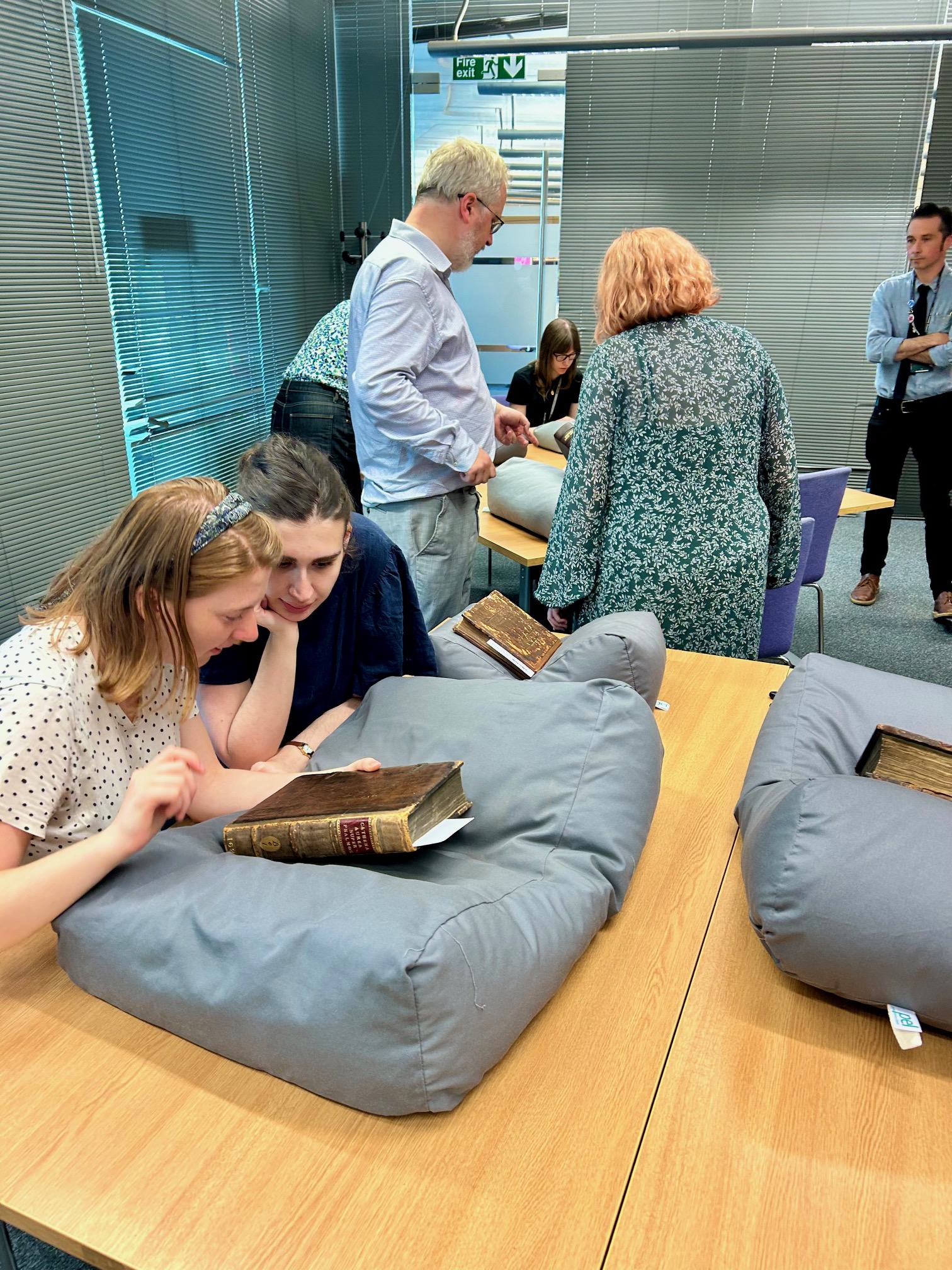
The latter half of the day in the Norfolk Heritage Centre allowed the group to explore how the library context of each historic collection influenced the development, use of, and access to the books. With the Heritage Centre occupying space in a public library and being assembled as a local studies collection, it faced different resourcing and access challenges to the cathedral library we had visited in the morning. At the Heritage Centre the group also had the opportunity to visit the storerooms and learn more about how the collection was catalogued, stored and preserved – seeing some of the practical work of conservation in action.
The books assembled for the workshop prompted a huge range of discussions across various aspects of book history and deep dives into the archaeology or biography of each object.
The St. Albans book, for example, offered a unique witness to a practice that never really took off in the English context, i.e. monastic houses operating their own presses. The blend of print and manuscript elements within the codex led to productive discussion of the ways the text might have been used, its intended audience, and the possible philosophy of the fragment use evidenced in the flyleaves. Detailed examination of this book in particular facilitated wide-ranging conversations on the palaeographical conventions of the late 15th century, print culture in late medieval England, the assumptions one can make about a text from the manner in which it is abbreviated, and so much more. It was useful for me personally to have had Tom guide me through the process of interpreting the book in such a way that has provided me with a methodological approach that I could use in the future.
Comparing different copies of the same book also allowed us to mull over this notion of the early printed book being a work-in-progress / unfinished object, that each individual owner could leave their own mark upon. The Heritage Centre’s copy of the 1493 Nuremberg Chronicle included decorative initials in red and blue that the copy in the Cathedral collection did not. On the other hand, the world map in the Cathedral copy had been corrected and altered according to its owner’s own preference. It raised questions about how each copy of the book might have been used. We considered the possibility of the decorated copy being purchased as a status piece, whereas perhaps the other copy found itself with an owner who was keener to engage with the substance of the text’s content.
Questions of ownership and the level of engagement with each text were also discussed by members of the group particularly interested in marginalia and ownership inscriptions. The provenance of the Heritage Centre collections, having been donated by wealth local families, meant that many of the books assembled for the workshop bore inscriptions that spoke to their histories as well-loved personal objects. Again, these books facilitated useful discussions about how one might go about establishing the provenance of a book and helpful tips on deciphering marginal inscriptions that might offer clues on how the text was received.
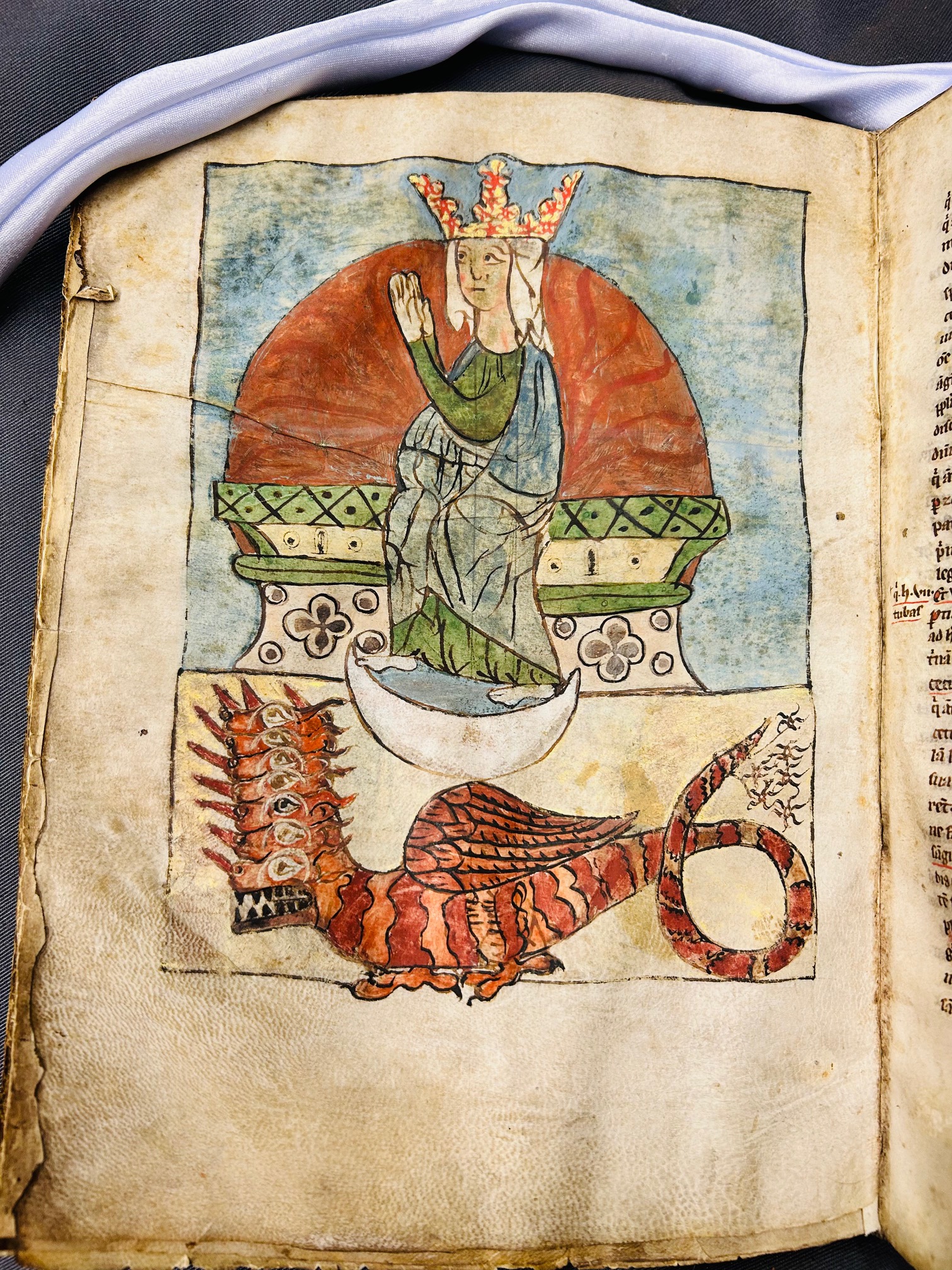
To wrap up a successful day of working with the two very different historic collections, we examined the 13th century Norwich Apocalypse book as a group. M R James’ scathing take on the illustrations in the book opened up a discussion about the process of commissioning and paying for the production of such an object. We considered questions of the availability of materials and what the quality of the artwork might suggest about the artist, or, indeed, the means of the patron as well as the fact that the visuals constituted one individual’s interpretation of the book’s religious subject matter.
Workshop Outcomes
- The materiality of the book: Through the workshop activities, the group had the opportunity to discuss a wide variety of the material processes involved in book making. We explored the use of fragments in binding, different kinds of binding, parchment production and papermaking, the presence of clasps and ribbons, illuminations and corrections.
- Navigating a library catalogue: Will provided the group with a useful resource on learning how to interpret an entry in a manuscript catalogue, demystifying the various details on the page.
- Considering the role of the library as a public space: The contrasting histories and uses of the two historic collections led to productive discussions around the historic and contemporary roles of library collections in the public sphere.
- Exploration of the manuscript-print relationship: Through examining manuscript fragments in printed texts, typeface styles, book decoration, hybrid books, and the use of marginalia, we were able to have interesting conversations on the interactions between manuscript and print and how they continued to influence one another long after the arrival of the print revolution.
- A further outcome of the event was that new collaborations were discussed between the Cathedral library and MEMRN, the CHASE-sponsored medieval & early modern research network, building on the working relationship developed during the MEMRN Winter Conference last year. We discussed opportunities for MEMRN to help raise the profile of the cathedral collection and other possible collaborative projects that could serve as useful training for CHASE students.
