

To see yourself as a mother who has been deeply involved in the upbringing of your child but for the law not to recognise you as a parent is a distressing situation to be in.
This is the exactly the position that Ms X found herself in when she contacted Kent Law Clinic for advice. She and her partner, Ms Y had chosen to start a family together in 2017. They had decided that Ms Y would carry the child as Ms X was in a financially more stable job at the time. They used a sperm donor to conceive their baby, and their daughter was born in 2018. Ms X separated from Ms Y in 2023, and although she continued to share a close loving relationship with her daughter, she was confronted by the fact that in the eyes of the law she was a legal stranger to her child.
Ms X had no right to obtain a prescription for her daughter when she was sick and she was unable to consent to medical treatment in an emergency. These issues had existed since her daughter was born, but when she was in a stable relationship with Ms Y it had not been such a pressing problem. Now she was a single parent, her lack of legal rights weighed heavily on her mind.
In 2023, Ms X sought help from Kent Law Clinic to understand why she fell outside of the law defining legal parenthood and what she could do to obtain some legal standing in her daughter’s life.
Working under the supervision of Clinic Solicitor, Philippa Bruce, students undertaking the Clinical Option module interviewed the client and established two key facts. The client and her former partner, Ms Y, had never been married or in a civil partnership. Secondly, the client and Ms Y had not used a licensed fertility treatment to conceive their child.
Researching the law on legal parenthood for same sex female couples, a group of clinic students established that legal provisions exist to give parental rights to second female parents like Ms X. They are set out under s42 Human Fertilisation and Embryology Act 2008 (HFEA). However, these rights extend only to those who are married or in a civil partnership with the ‘Mother’ which is defined in law as the person who carries and gives birth to the child (s33 HFEA 2008).
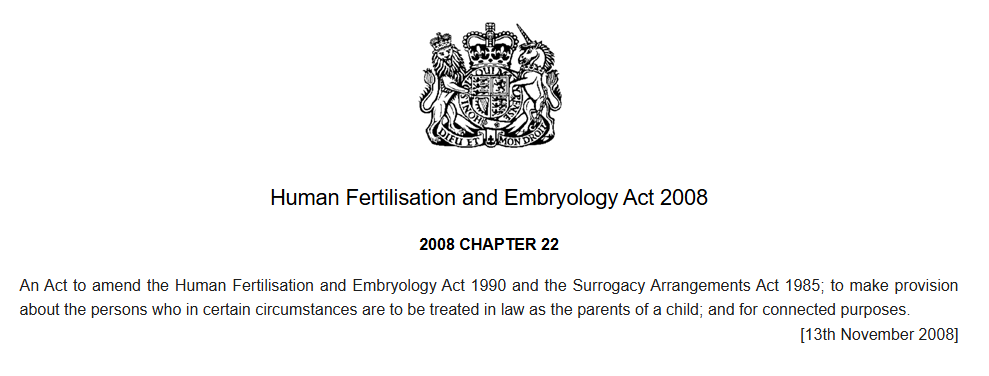
The Clinic team reflected upon how the law appears to favour those who conform to the traditional societal model a family – the heteronormative married couple – and questioned why s42 HFEA was drafted in such a way as to only protect those who had married or entered in to a civil partnership.
Further research established that parental rights can be granted to unmarried second female parents if certain conditions are met, but this only applies if a licensed fertility clinic was used to conceive the child (s43 HFEA). This gave the students cause to also reflect on how the law sometimes better protects those with money who can afford fertility treatments.
Ms X’s case involved other complexities that are not relevant to this short article, but what resonated with the students working on the case was the emotional impact not being legally recognised as a parent had had on Ms X over the seven years of her daughter’s existence. It had taken its toll.
Kent Law Clinic solicitor, Philippa Bruce advised Ms X that her only way to acquire some legal standing in her daughter’s life was to acquire parental responsibility. Given the crucial facts set out above, the Clinic established that legally there was only one way to achieve this – applying for a Child Arrangement Order. This was because the ‘normal’ means of acquiring parental responsibility, which included reaching an agreement with the Mother, or applying for a Parental Responsibility Order were not avenues open to the client because she did not come within s42 or s43 HFEA’s definition of a second parent.
There is a provision in the Children Act 1989 which allows a non-parent to acquire parental responsibility if a Child Arrangement Order is made (this crucial provision is set out in s12(2) and 12(2A) CA 1989). Ms X was advised that she could apply for a Child Arrangement Order and ask the Court to use its discretion to grant her PR at the same time. However, this meant accepting that in the eyes of the law she was for the time being a non-parent.
In support of her application, the Clinic helped Ms X to formulate an argument that demonstrated her strong commitment to her child’s life, showed the deep loving relationship that existed between her and her daughter and explained that her application was motivated only by her desire to further her daughter’s welfare and confirm her status. Clinic Module students Tahlia Grant and Joshua Smith were instrumental in preparing a detailed and impassioned witness statement for Ms X which set out the facts in support of her position. At a final hearing at Canterbury Magistrates Court in April 2025, Clinic Solicitor, Philippa Bruce represented Ms X and helped her to obtain a child arrangement order with parental responsibility. This was a significant moment for Ms X as for the first time in 7 years, she was legally recognised as a person of significance in her child’s life; put simply, she was finally ‘seen’ by the law as a parent.
Philippa commented: “Despite the clear loving relationship between this parent and her daughter, she always felt inferior while she lacked legal responsibility. I am thrilled for Ms X that finally her position is legally recognised, but it is such a shame that it took the Clinic’s intervention and some very stressful court proceedings to make this happen.”
As well as being a Clinic Solicitor, Philippa Bruce is also a Senior Lecturer in Kent Law School and teaches on the Family Law module convened by Dr Julie McCandless. In response to the case, Julie commented: “The provisions in the Human Fertilisation and Embryology Act 2008 work out from the traditional nuclear family of a married heterosexual couple having bio-genetic children. While extending the legal parenthood provisions out to some same-sex female partners was a welcome development, mirroring the same-sex provisions on those designed for heterosexual families has meant that many LGBTQI+ parents remain excluded from legal recognition. This is problematic for parents and children, particularly when parents separate. Fertility treatment is expensive and same-sex people can be excluded from NHS provision. Informal sperm donation is common and needs to be countenanced in the legal framework.”

The opportunity to learn about the law from the perspective of the client allowed the Clinic students to really understand the impact of this hetero-normative approach. It also gave them an opportunity to work for a client and make a difference. Tahlia explained: “Working on Ms X’s case was a humbling insight into what so many face in our legal system. It’s one thing reading a case but actually meeting a client and being able to take charge of certain important aspects of her case was a privilege and something I will never forget. It was a privilege that hit home when I realised our work helped a mother rebuild a bond with her daughter, a relationship the law had once brushed aside. That is something I’ll carry with me.”
The last word should perhaps go to Ms X herself. On the conclusion of her case, she said: “I am beyond overwhelmed with gratitude to the entire Kent Law Clinic team. You not only gave me hope when I had none, but you truly saw me when I had started to doubt myself. I am forever grateful to each and every one of you for standing by me, for fighting to ensure my voice was heard, and for helping the law finally recognise the truth of my motherhood. Philippa once said “a child’s life should be defined by love, not loss!” Thanks to all of you, that belief has now become a reality. You have changed my life. From the depths of my heart, thank you.”
The whole Clinic team are delighted for Ms X and wish her and her family the best for the future.