
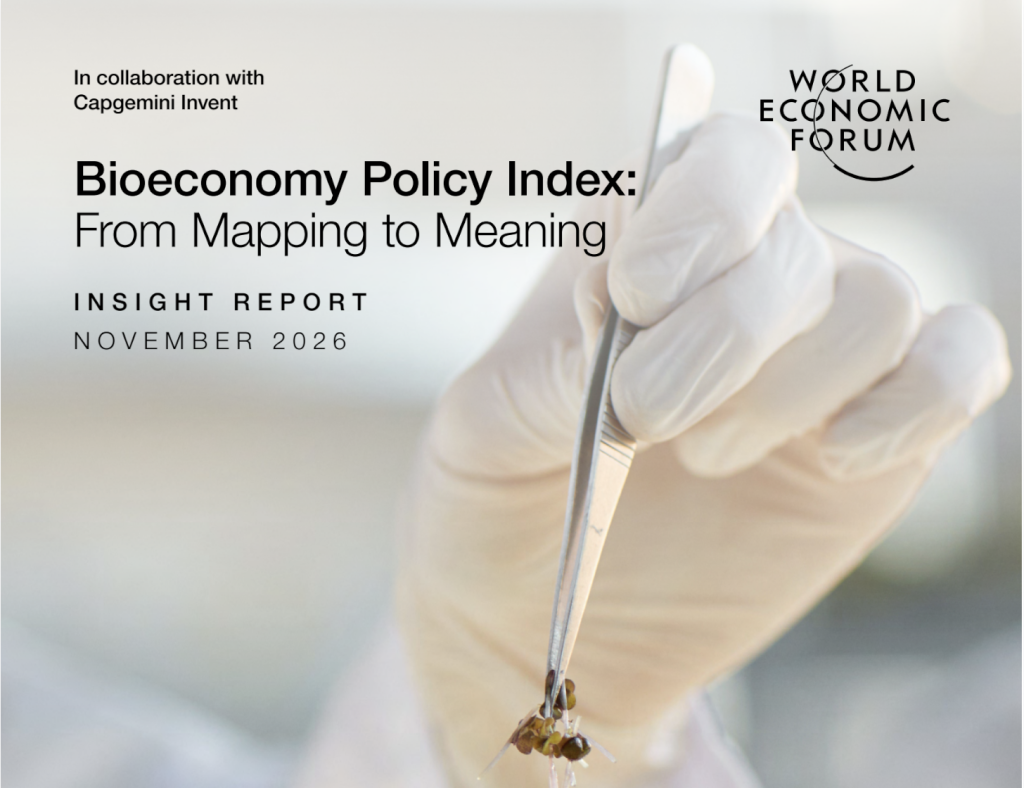
Professor Joy Y. Zhang, Founding Director of the Centre for Global Science and Epistemic Justice, is a co-author of the Foreword to the World Economic Forum’s latest report, Bioeconomy Policy Index: From Mapping to Meaning, published on 10 November 2026. Professor Zhang also contributed to the report’s review process.
Developed by the World Economic Forum in collaboration with Capgemini, the report examines how governments are translating growing ambitions for the bioeconomy into concrete policy measures and measurable outcomes.
Drawing on an analysis of more than 900 policy instruments across seven geographies, the report identifies a persistent gap between policy ambition and demonstrable impact. While governments have invested substantially in supporting research, innovation and production capabilities, comparatively little policy attention has been directed towards creating markets and stimulating demand for bio-based products and services. The report also highlights significant gaps in the evaluation and reporting of policy outcomes, making it difficult to assess which interventions are delivering meaningful results.
To address these challenges, the report proposes four priorities: strengthening market creation, tailoring policy instruments to specific sectors and applications, embedding evaluation into policy design, and establishing common standards for reporting outcomes.
For GSEJ, the report highlights the importance of bringing economic policy and the social governance of emerging technologies into closer conversation.
Reflecting on the report, Professor Zhang commented:
“It is encouraging to see economic planning paying greater attention to how policy environments shape the development of the bioeconomy. Equally, I think researchers working on governance, ethics and regulation need to pay closer attention to the evolving economic structures and organisation of bioeconomy production chains. Without understanding how these industries actually develop, operate and create value, it is difficult to produce ethical and regulatory recommendations that are both relevant and effective.”
This perspective resonates with GSEJ’s wider research agenda on the governance of emerging life sciences, which seeks to connect scientific innovation with its evolving social, economic and political contexts.
Read the full report: Bioeconomy Policy Index: From Mapping to Meaning — World Economic Forum