
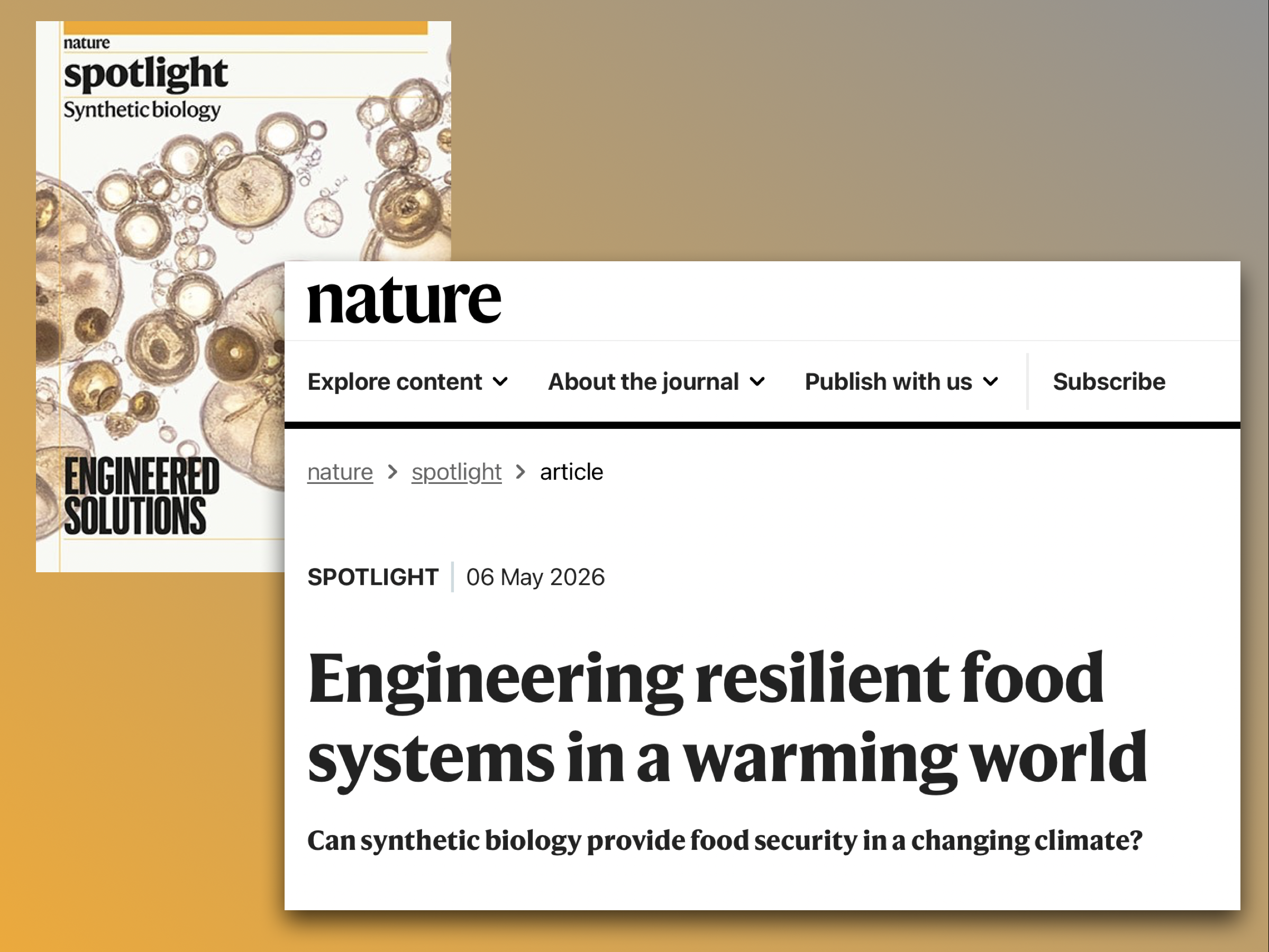
We are pleased to share that Futuring Biological Commons, a project hosted by GSEJ, has been featured in a recent Nature spotlight article, Engineering resilient food systems in a warming world, which examines how synthetic biology is being positioned as a response to growing climate pressures on global food systems.
The Nature article highlights the project’s work on promoting ‘open communication between scientists, policymakers, industry, farmers and the public’, recognising that successful innovation depends not only on scientific breakthroughs but also on how different communities understand and respond to these technologies.
Led by Professor Joy Y. Zhang, Director of GSEJ, the ARIA-funded Futuring Biological Commons project examines the social and ethical dimensions of crop synthetic biology alongside ongoing scientific developments in the field. The article specifically points to the project’s emphasis on ‘differentiated, coordinated social uptake’. As Professor Zhang explains, there is no single pathway for adopting synthetic biology technologies, and public attitudes are likely to vary across different communities and contexts — even within the same country. This challenges assumptions that public acceptance can be treated as uniform or addressed through one-directional science communication alone.
Nature also highlights findings from the project’s engagement work along England’s east coast, where ‘pendulum futuring’ focus groups revealed that participants were often more curious and open to synthetic biology in agriculture than researchers had initially expected. Reflecting on these findings, Professor Zhang argues that public perceptions of science have shifted over time: from seeing science as a tool that expands human choice to seeing it as something that imposes change upon society. Rebuilding trust, she suggests, requires restoring that earlier understanding of science as something that enables people to have ‘more life options’.
The feature reflects GSEJ’s wider commitment to developing more inclusive, globally attentive, and socially responsive approaches to science governance. At a time when synthetic biology is increasingly presented as part of the solution to climate and food-system challenges, the article highlights the importance of ensuring that these futures are shaped not only in laboratories, but also through open, context-sensitive, and participatory public engagement.