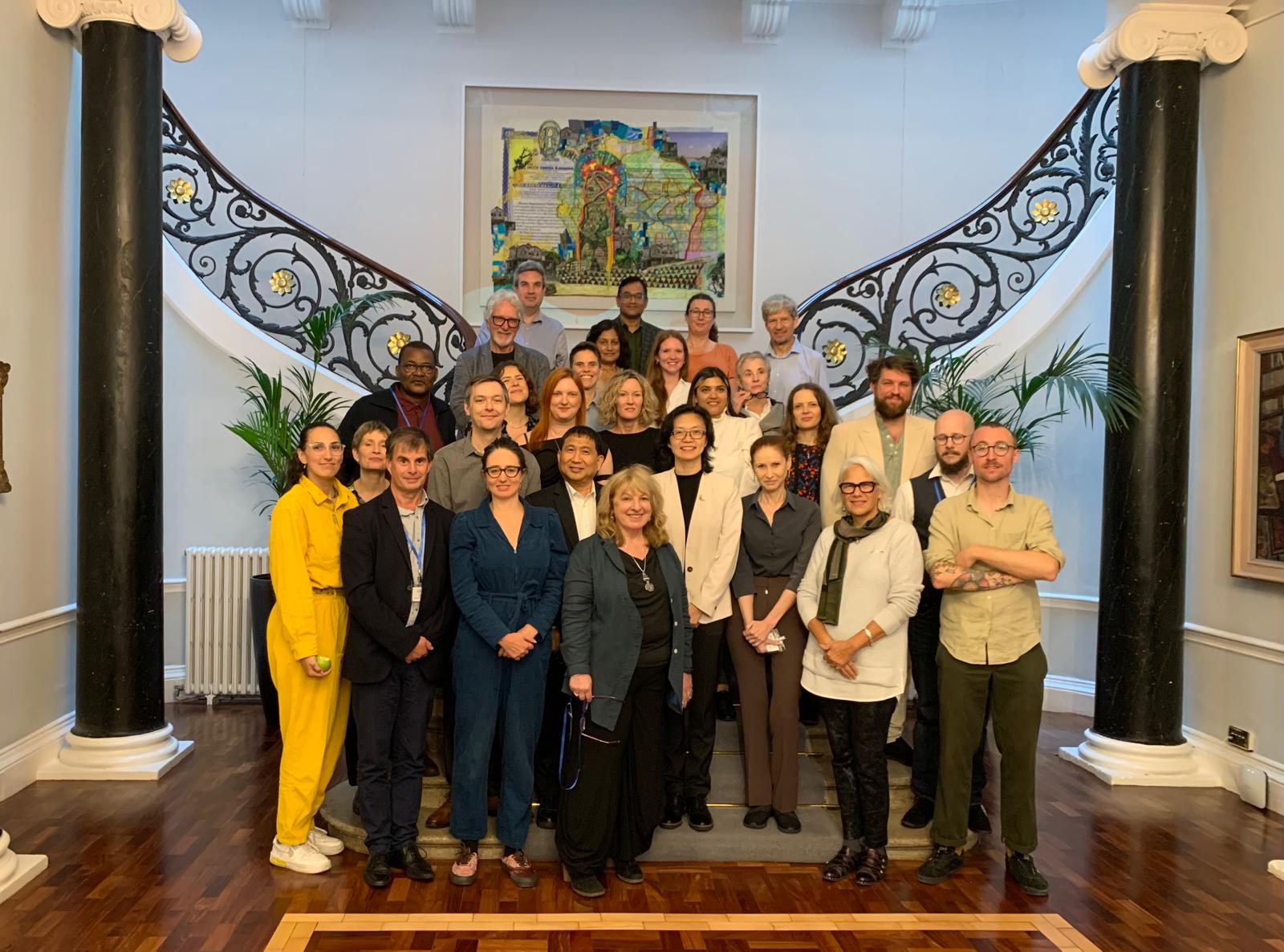
On 29–30 September 2025, the Centre for Global Science and Epistemic Justice (GSEJ) hosted A New Odyssey for Public Engagement at the British Academy. This invitation-only event brought together leading thinkers, science diplomacy experts, and scientists from four continents to explore how the O.D.E.SS.I. framework—Open, Deliberative, Enabling, Sensible and Sensitive, Innovative—can guide global practices of public dialogue on science.
Developed through years of international collaboration, O.D.E.SS.I. has been shaped by ongoing dialogue with pioneers who have expanded the boundaries of public engagement and science diplomacy. The framework’s five pillars are intentionally interwoven, each informing and conditioning the others. While participants were well positioned to speak across the full spectrum of engagement, the two-day programme was structured around four thematic blocks to enable focused exploration:
-
Day 1 (Morning)- Open. Deliberative: What do “openness” and “deliberation” mean in different cultural and scientific contexts? How might these pillars shape science–society relations in the decades ahead?
-
Day 1 (Afternoon) – Deliberative. Enabling: How can deliberative processes become actionable without losing inclusivity? What does genuine enablement look like across institutions and communities with divergent priorities?
-
Day 2 (Morning) – Sensible and Sensitive: How can consensus and compromise become creative tools for transnational science governance? Participants considered how diplomatic engagement and bridge-building might help societies make collective sense of uncertainty, disagreement, and hope.
-
Day 2 (Afternoon) – The ‘I’ in We: What shared framework for recognition and communication is needed to build responsible and just science? How might public engagement foster epistemic justice and diplomatic capacity in science across global communities?
Notably, Innovation did not appear as a standalone theme—reflecting the assumption that innovation permeates every discussion. The final session, The ‘I’ in We, drew inspiration from Axel Honneth’s work on recognition and ethical life. It invited participants to reflect on how interactions with the world shape our sense of collective belonging and how public engagement might cultivate a shared grammar of communication and mutual recognition—cornerstones of social freedom in science and its uptake.
Highlights and Acknowledgements
Keynote speakers Mr. Shaofeng Hu (UNESCO) and Professor Françoise Baylis (Dalhousie University / President-Elect, Royal Society of Canada) set the tone for the event, offering profound insights into how the O.D.E.SS.I. framework could advance both public engagement and science diplomacy during the UN’s International Decade of Science for Sustainable Development.
Their contributions were complemented by an outstanding roster of speakers and discussants, including Tracey Brown, Robin Lovell-Badge, Ian Wiggins, Natalia Pasternak, Bankole Falade, Martin W. Bauer, Trupti Patel, Annette Boaz, Jan Marco Müller, Amit Kumar, Emma Cook, Rebecca Asher, Alice Howarth, Michael Marshall, Annette Markham, and David Ludwig. Their transdisciplinary and transcultural insights enriched the discussions and helped to situate O.D.E.SS.I. within a truly global conversation.
GSEJ also extends heartfelt thanks to Sophie Gilbert, Katie Dow, Lynn Frewer, Julian Little, Emily Jesper-Mir, Trude Diesen Sundberg, Nita Pillai, and Philippa Michael for their thoughtful comments and logistical support.
Finally, special recognition goes to the GSEJ team—Oliver Pritchard-Moore, Ceylan Hassan, Matthew McKenna, and Camille Serisier—whose dedication ensured both the smooth delivery and intellectual depth of the event.
See Final-ODESSI-Sept-London-programme and ODESSI – Attendee Profiles
Looking Ahead
The conference underscored the importance of curiosity-driven public engagement as a foundation for the social architecture of science—an approach that enables long-term dialogue, epistemic socialisation, and inclusive participation in shaping the future of science and innovation.
A full conference report will be published shortly.