
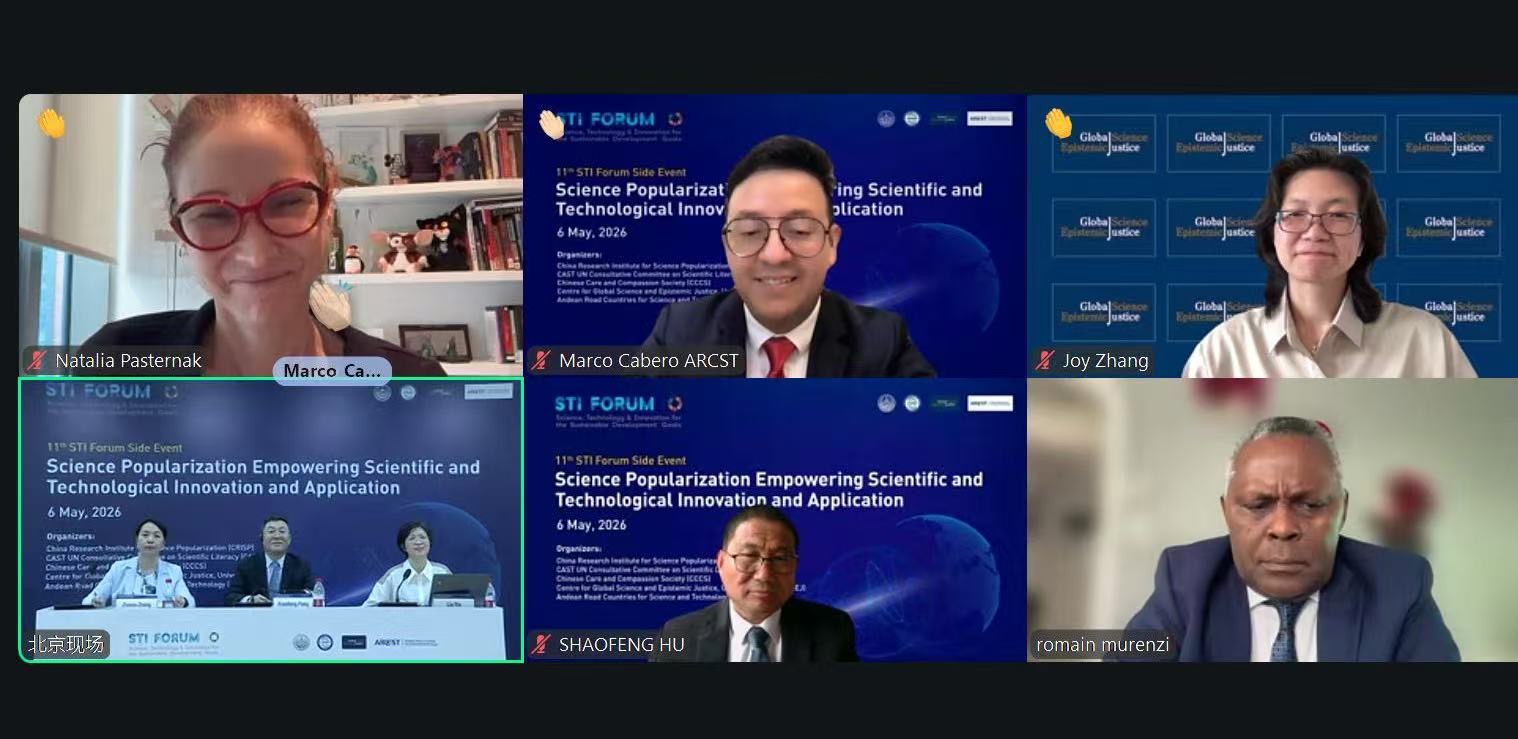
In the early afternoon of 6 May, the Centre for Global Science and Epistemic Justice (GSEJ), University of Kent, together with the China Association for Science and Technology United Nations Consultative Committee on Scientific Literacy (CAST-CCSL), in collaboration with the Chinese Research Institute for Science Popularization (CRISP), the Chinese Care and Compassion Society (CCCS), and the Andean Road Countries for Science and Technology (ARCST), co-organised an online side event titled Science Popularization Empowering Scientific and Technological Innovation and Application during the 11th United Nations Multi-stakeholder Forum on Science, Technology and Innovation for the Sustainable Development Goals (STI Forum).
The UN STI Forum is a key platform of the Technology Facilitation Mechanism under the 2030 Agenda for Sustainable Development. The 11th Forum was held at the United Nations Headquarters in New York from 6–7 May 2026 under the theme: “Transformative, equitable and coordinated science, technology and innovation for the 2030 Agenda and a sustainable future for all.” The side event brought together scholars, policymakers, and practitioners from UNESCO, international civil society organisations, universities, research institutions, and industry associations across the world.
The session featured keynote contributions from six international experts.
Shaofeng Hu, Director of the Division of Ethics, Research and Technology, UNESCO, identified unequal access to science and the spread of misinformation as two major obstacles to the UN vision of “science, technology and innovation for sustainable development and for all.” He emphasised the importance of science popularisation and introduced UNESCO’s ongoing research and initiatives in this area. He also outlined six major global policy gaps as well as five strategic pillars and implementation pathways.
Zhimin Zhang, Director of the Division of International Cooperation at the Chinese Research Institute for Science Popularization (CRISP), argued that science popularisation and dialogical public engagement are essential foundations for the inclusive social uptake of scientific and technological innovation. Achieving the equitable sharing of knowledge and scientific progress envisioned in the SDGs requires embedding scientific thinking into everyday culture and public life. She highlighted the role of science popularisation in strengthening scientific literacy and evidence-based reasoning, reducing misinformation and irrational fears, and safeguarding the public’s right to participate in and benefit from scientific advancement. She further stressed the importance of integrating science popularisation into national STI strategies and promoting lifelong scientific literacy through educational systems, public institutions, and media engagement.
Joy Zhang, Professor at the University of Kent and Founding Director of the Centre for Global Science and Epistemic Justice, examined the generational shifts in public attitudes and expectations toward genomic engineering, alongside the phenomenon of “science at large” emerging within this frontier field. She analysed how increasing social diversity and ideological divides necessitate new approaches to science communication and public engagement. Referring to the internationally collaborative O.D.E.SS.I. initiative on genomic engineering, launched last year by several participating experts, she highlighted the inseparable relationship between science diplomacy, science communication, and the ethical governance of emerging science, while calling for broader interdisciplinary participation and collaboration.
Natalia Pasternak, President of the Institute Question of Science in Brazil and Professor at Columbia University, drew on her extensive experience combating misinformation to emphasise the importance of recognising and responding effectively to the incentive structures underlying medical and health misinformation. Using both qualitative and quantitative evidence, she argued that science communication must remain attentive to audiences’ cultural and political contexts and make science more relatable to everyday concerns and lived experiences. She further noted that countering misinformation is not a one-off act of debunking, but rather a sustained process involving pre-bunking, debunking, and long-term public engagement.
Romain Murenzi, former Executive Director of TWAS and former Rwandan Science Minister, highlighted the importance of science diplomacy through his long-standing efforts to promote transnational scientific literacy. He pointed out that artificial intelligence has created both new opportunities and new challenges for science communication, while specifically identifying AI literacy and data literacy as two foundational yet often overlooked dimensions of holistic scientific literacy. He further emphasised the value of citizen science initiatives in empowering broader public participation and ensuring that technological development remains grounded in lived social realities.
Marco A. Cabero Z., Chairman of the Andean Road Countries for Science and Technology (ARCST) and Director of the Journal of Latin American Sciences and Culture (JLASC), stressed the importance of the two-way nature of science popularisation, arguing that its goal is not simply to “transform” the public, but to foster deeper integration between science and culture. Drawing on ARCST’s work, he highlighted the importance of transdisciplinary collectives in translating science into cultural identity. In this sense, he argued, science communication enhances both society’s “cultural readiness” for science and science’s own cultural adaptability. He also emphasised the importance of inspiring future talent from an early age, citing the Children-Led Innovation in Action initiatives in China, Bolivia, and Mexico as examples of young people’s significant potential in innovation and social participation.
An official report of the event and related policy recommendations will be published on the UN website in due course.