
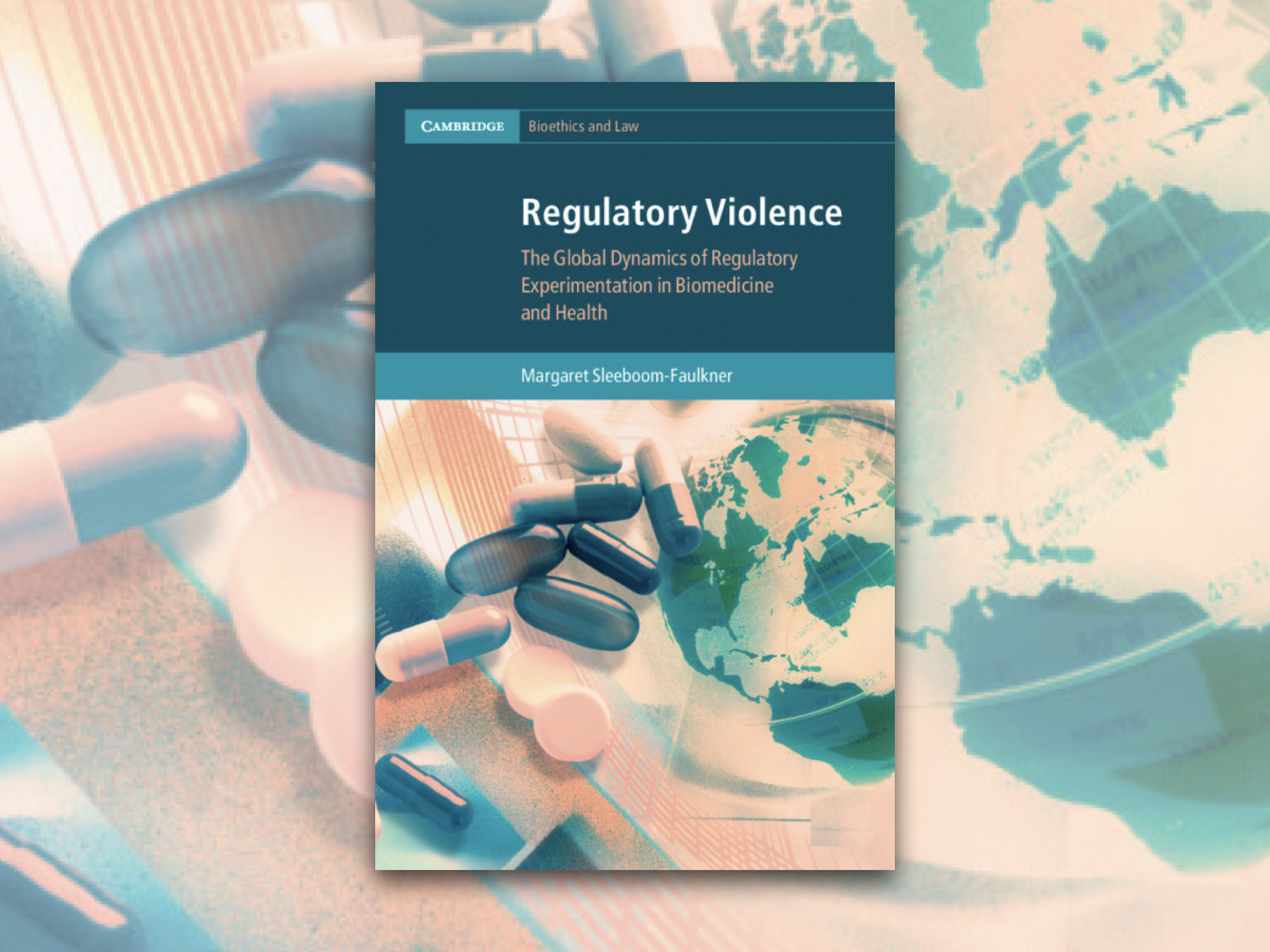
We are delighted to announce that we will be hosting a joint staff seminar of the Centre for Global Science and Epistemic Justice (GSEJ) and the School of Social Science at 16:00 on Thursday, 13 November 2025. The seminar will feature Professor Margaret Sleeboom‑Faulkner, Professor of Social & Medical Anthropology at the University of Sussex, who will discuss her 2025 book Regulatory Violence: The Global Dynamics of Regulatory Experimentation in Biomedicine and Health.
Professor Sleeboom-Faulkner is an internationally recognised scholar of social and medical anthropology whose work bridges anthropology, ethnography and science & technology studies (STS). Holding a doctorate from the Amsterdam School for Social Science Research, her research examines state formation in East Asia, global life-science networks, and the governance of emerging biotechnologies. She is widely known for her influential analyses of biobanking, stem-cell therapies and regulatory experimentation in biomedicine, and for illuminating the ethical and political challenges that shape global health innovation.
Venue: Cornwallis East Seminar Room 2
(Enter via the Darwin bus stop entrance, ground floor, turn right, the seminar room is at the end of the corridor)
Abstract
Neoliberalism is presumed to enable free competition in an international environment, unfettered by the constraints of regulation. Nevertheless, clinical and research regulation are put in place to prevent the mishaps associated with biomedical experimentation and to optimize scientific development. Although, since World War II, countries around the world have not only exponentially increased their biomedical regulation, they also have instrumentalised it to increase their competitiveness, both at home and internationally.
At the same time, many concerned interest groups, including biomedical industry, healthcare providers and patient groups call for the improvement of regulation, and the international harmonization of regulation to facilitate the responsible development of new biomedical innovation. In addition, ‘international science collaboration’ is advocated as means to improve the ethical and scientific capacity of what are viewed as rogue countries.
Using anthropological case-studies of the development of regenerative medicine in Asia and beyond, I show why the many struggles to ‘improve’ biomedical regulation have led to regulatory violence, and how international collaborations have instrumentalized regulation in ways that are detrimental to both patients and science. I suggest that in the absence of a global institution that has sufficient authority to mediate the local interests of patients, science and healthcare provision, radical changes in how we deal with health resources are called for.
This seminar is based on materials from Regulatory Violence. The Global Dynamics of Regulatory Experimentation in Biomedicine and Health, CUP, May 2025.