
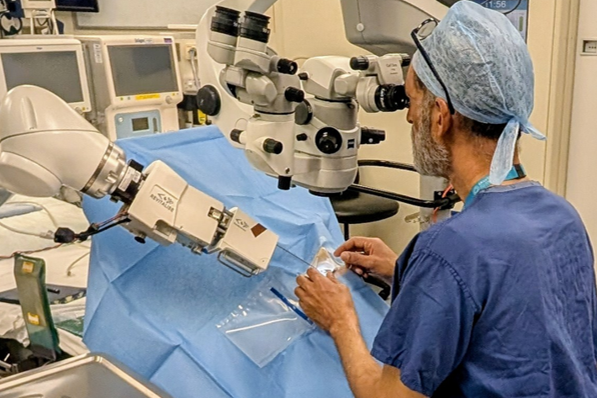
Professor Adrian Podoleanu, Dr Michael Hughes and Dr Manuel Marques from Kent’s School of Engineering, Mathematics and Physics are part of a collaborative research team who have been awarded £2.2 million by the National Institute for Health and Care Research (NIHR) to develop a flexible surgical robot for delivering vision-restoring therapies into the eye.
Retinal vascular diseases are conditions that affect the blood vessels of the retina, such as diabetic retinopathy (DR) and retinal vein occlusion (RVO). These conditions affect more than 200 million people worldwide and are a leading cause of blindness. Current treatments are costly and only slow disease progression, so there is a need for therapies that restore as well as preserve vision.
New therapies have shown promise in restoring vision in early trials. However, these treatments must be delivered directly to retinal blood vessels that are thinner than a human hair. This is almost impossible to do by hand because of natural hand tremors, small patient movements and limitations of current tools.
The research team led by Professor Christos Bergeles (King’s College London) and Professor Lyndon da Cruz (Moorfields Eye Hospital), has developed a new type of eye surgery robot to address this challenge. Unlike the straight, rigid tools used today, their robot is flexible and can bend like an elephant’s trunk. This means surgeons can approach the retina from different angles and reach blood vessels in ways that are impossible by hand. For robot guidance at these microscopic scales, Professor Adrian Podoleanu, Dr Michael Hughes and Dr Manuel Marques are developing sophisticated miniaturised optical devices.
The current version of the robot is used to precisely position a surgical light during eye operations. Over the three-year project, funded through an NIHR Invention for Innovation Product Development Award, the team will test the robot in five patients to assess its safety, usability and performance. They will also expand the robot’s functions so it can deliver drugs directly into tiny retinal veins, and they will prepare the regulatory documentation needed so the robot can be approved for treating blocked blood vessels with the “clot-busting” drug t-PA.
The team plans to eventually deliver the technology to the NHS and beyond through Revitalise, a spinout company under development. Revitalise completed the London Institute for Healthcare Engineering’s MedTech Venture Builder, and will de-risk their platform through ISO certification, clinical evaluation and regulatory readiness. The spinout was recently named one of five companies to watch at LSI USA 2026, where it was publicly recognised by LSI’s intelligence platform, Compass AI, for its translational ambition and commercial potential.
Congratulations to Adrian, Michael and Manuel!