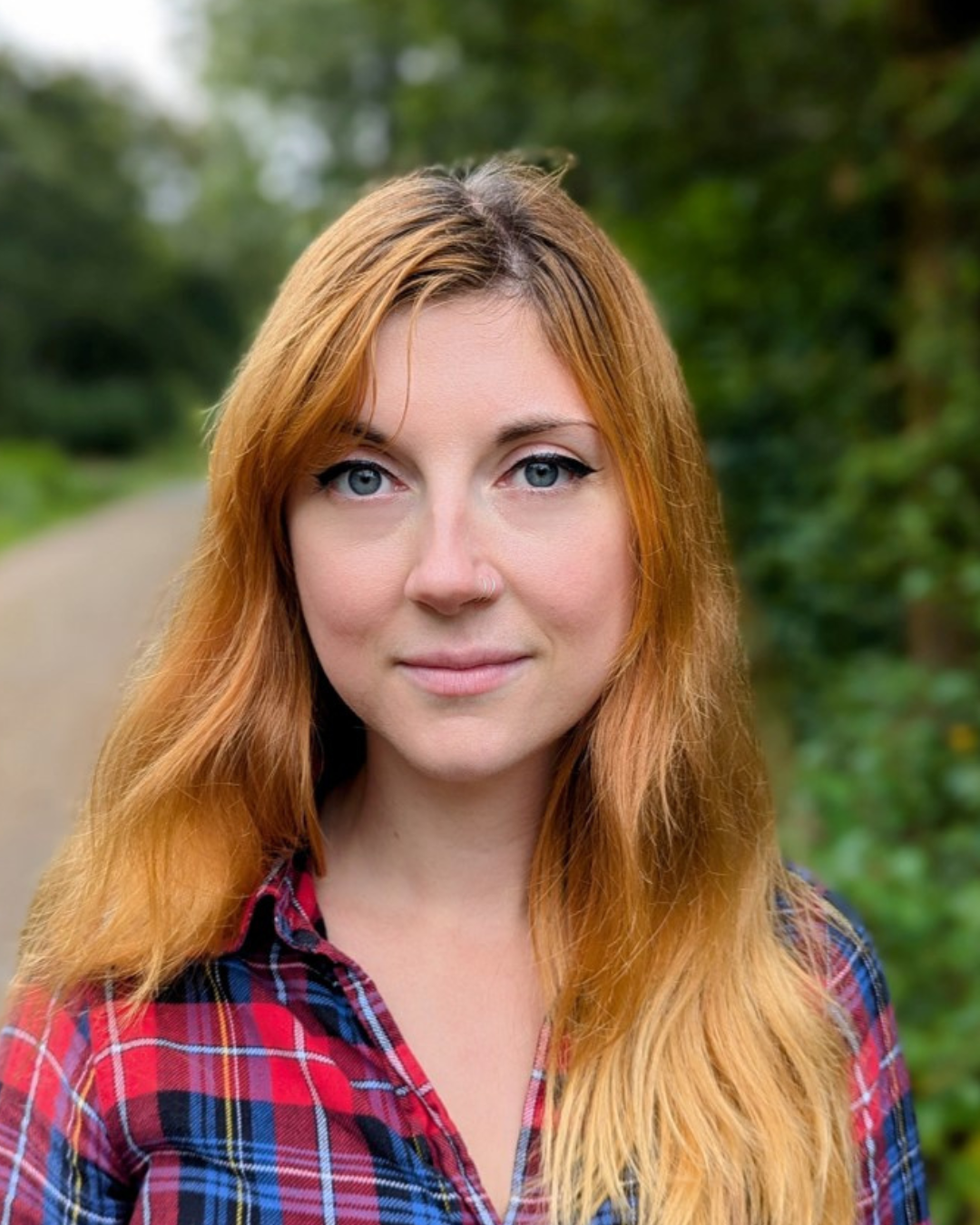
Hi Sophie, thanks for being this month’s spotlight! Can you tell us a bit about your research project?
My PhD looks at how ‘farm women’ (women who live on, own, or manage farms) in southeast England engage with their farms and how this impacts the environment. Given that 71% of the UK is farmland, and given that agriculture accounts for ~12% of the UK’s annual greenhouse gas emissions, it’s crucial that those in agriculture have a seat at the table when discussing how best to protect our environment. Farmers are increasingly involved in agri-environmental policy, but so far, farm women are not consulted (or even considered) when discussing how best to care for our environment. This is despite the fact that the bulk of farms in England are family farms, often co-owned (and increasingly run or co-run) by farm women.
Nevertheless, my pilot research indicates that farm women are already undertaking pro-environmental practices, albeit not always through ‘official’ farming channels (such as government subsidies or the NFU). My PhD explores this in greater depth, ultimately hoping to expand our understanding of how farm communities can engage with the environment while balancing food security and business concerns.

What made you choose this area of study?
Personally speaking, I was raised in a Kentish farming valley and partly grew up on a farm. The farmers around me cared deeply for their land, which didn’t marry up with the depiction of environmentally-destructive farmers that I was increasingly seeing in the headlines. I wanted to understand why farmers were gaining this reputation and what could be done to help encourage eco-friendly farming practices. This was the basis of my pilot research – but it soon became clear that many women (female farmers, certainly, but also farmers’ wives, daughters, and mothers) were often leading the charge in championing environmentalism on their land. Completely of their own volition, they were digging newt ponds, leading birding groups, and conducting public outreach in an effort to support the environment, not destroy it – often in addition to their own workloads, to-do lists, and caring responsibilities, and usually without any pay. Given the lack of academic interest in this group of people, and the potential impact of engaging this massive group of environmental allies, I knew I had to learn more. What else are farm women up to? Do they experience any barriers to environmental engagement? And how could their environmental actions be supported by policy
Academically speaking, there is plenty of work analysing how farmers approach environmentalism in their business – but most of that research only samples one farmer from each farm (disproportionately men). But in the context of the family farm (which comprises the majority of farms here in England), this ignores everyone else in the household who might have input – namely farm women, who often co-own farms. So (at least on paper) these women have equal say in how a farm is run, but this is ignored by current research. My project hopes to remedy this by looking at the role of farm women on the land, and how this impacts the environment.

What is your favourite memory or story from your research so far?
Honestly, being welcomed into people’s homes is always such a joy. The women I’ve met have always been so warm and friendly, offering me cuppa after cuppa, letting me play ‘hide and seek’ with their kids, and waiting patiently while I make friends with their dogs. I’m often sent home with eggs, fresh juice, and apples – and on one occasion, I almost left with a kitten.
The best part of my research is that I conduct walking interviews – the interviewee and I walk across the farm as we chat (often alongside a gaggle of dogs and kids). On one walk, a farmer’s pre-school son took the lead on the farm tour, proudly showing me where the quails and chickens and pigs lived – and squealing excitedly when he spotted some freshly laid eggs in the chicken coop. He collected them up for me, and when I left, I was sent home with a carton of delicious eggs.

Another special memory was when I was walking with a new mum and her 12-week-old son. We greeted her herd of cows (some of the friendliest cows I’ve ever met – they really are just huge dogs) and talked about the future of farming while she nursed her baby who (hopefully) would one day take over the farm. It was a really special moment.
Thanks for being this month’s spotlight, Sophie, and best of luck with your continued research. You can find out more about Sophie on her student profile.