
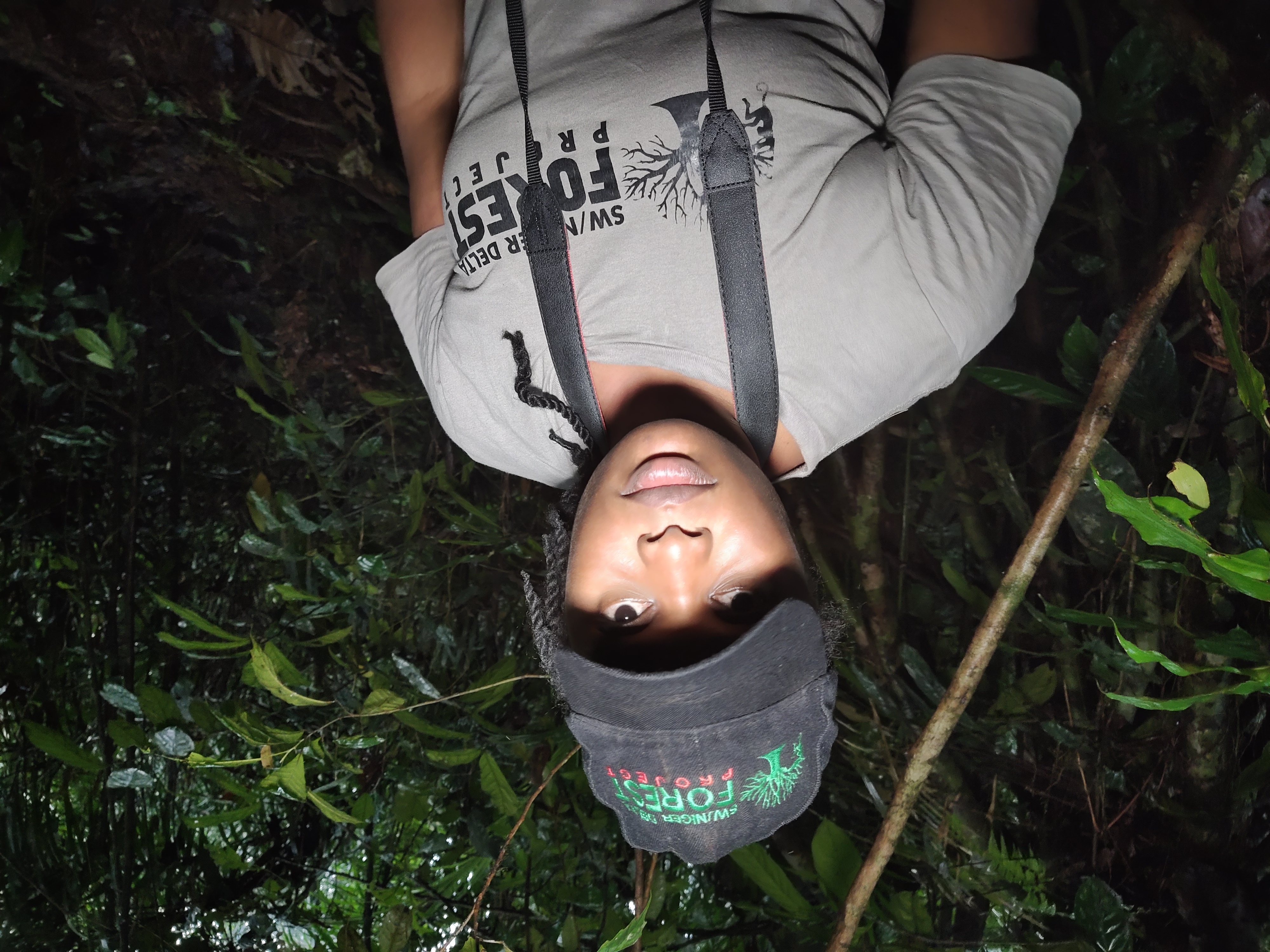
Rachel Ashegbofe Ikemeh is a Nigerian conservationist and winner of a Whitley award in 2020, who studied at DICE between 2014 and 2015. She is now the director of South West and Niger Delta Forest Project, a conservation program for endangered primates.
Hi Rachel, what have you been doing since graduating?
I am a Nigerian conservationist, biodiversity management strategist, and change advocate. I founded the SW/Niger Delta Forest Project in 2012, a conservation initiative focused on grassroots efforts, which has recently expanded into a dynamic team of 93 members recruited from local institutions and indigenous communities. We are implementing critical interventions for threatened ecosystems and species in the complex socio-ecological landscapes of Southern Nigeria. Together with my team, I have led successful campaigns and actions to protect critical species on the verge of extinction, resulting in the establishment of four new protected areas and promoting sustainable land-use practices. We are the only NGO/group in Nigeria that has spearheaded the creation of protected areas amongst other pioneering initiatives. I have been Co-Vice Chair of the Africa Section of the IUCN/SSC Primate Specialist Group since 2016, co-founded the African Primatological Society in 2017, serve on the International Primatology Society (IPS) education and election committees, and recently joined the Board of the Swiss-based Forest Conservation Fund. I was also recently nominated to the Great Apes Survival Partnership (GRASP) Scientific Commission.
How do you feel your time at DICE prepared you for the work you are doing now?
My time at DICE was pivotal in shaping my career, providing me with the requisite skills and knowledge to tackle complex conservation challenges. The intensive training I received in Conservation Project Management helped significantly to improve my understanding in project planning, ecological complexities, and stakeholder engagement. It also ingrained in me a deep appreciation for the integration of scientific research with practical conservation efforts.
The diverse and multidisciplinary setting at DICE exposed me to various perspectives and methodologies, which have proven invaluable in my professional endeavours. Furthermore, the network of peers and mentors I established during my study continues to inspire me and keep me grounded, reminding me that after all, conservation in practice is a shared experience and rooted in quality collaborative work.
In summary, DICE has equipped me to adeptly navigate my multifaceted role and to lead my impactful conservation projects with confidence and proficiency.
What do you consider to be the highlight of your time at DICE?
One of the highlights of my time at DICE is working alongside a diverse group of fellow students and faculty, I was able to engage in hands-on activities, field trips that brought theoretical concepts to life. This not only solidified my understanding but also fostered a sense of community and collective purpose.
Additionally, the mentorship I received during my year-end project/thesis was invaluable. Being guided by an experienced conservationist and academic – Professor Bob Smith – allowed me to refine my approach and gain insights that have proven pivotal in my current initiatives, particularly in strategic conservation planning.
_
Thanks for being this month’s spotlight, Rachel. All the best in your amazing work!