
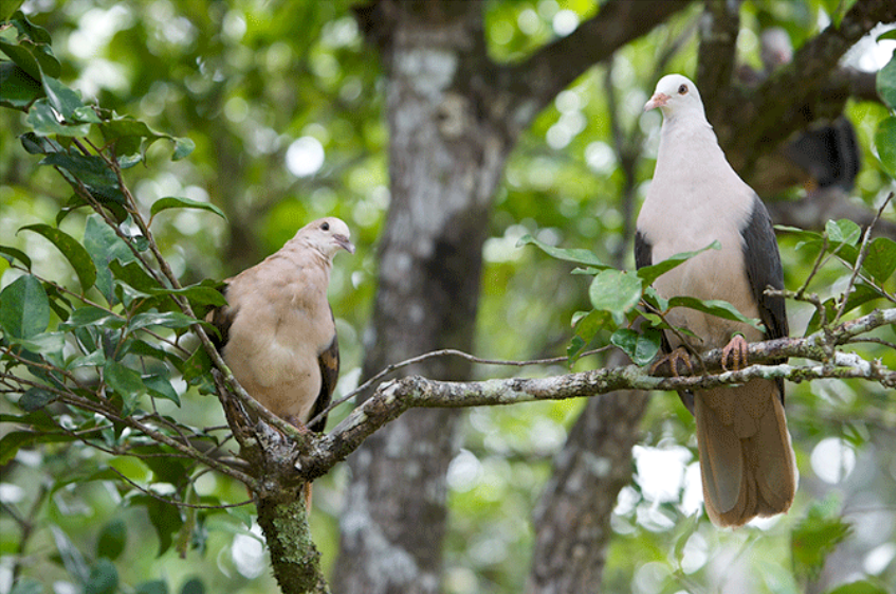
Species saved from the brink of extinction, including many of today’s most iconic conservation success stories, still suffer the consequences of their ‘near misses’. Recovering from extremely small population sizes (population bottlenecks) can hinder long term survival due to loss of genetic diversity. The challenge now is figuring out what long-term support is required for effective genetic management.
Long-term studies of populations of threatened species are changing the way conservation scientists understand what it takes to fully recover from a severe population bottleneck, such as our earlier work on the pink pigeon on Mauritius (Jackson et al. 2022). Despite a dramatic conservation-led recovery from less than 12 birds in the entire species to ~450 today, its genetic diversity continues to decline. While this demographic recovery led to the downlisting of this species on the IUCN Redlist from Critically Endangered to Vulnerable, the genomic erosion indicates that long term, this species may still be at high risk of extinction. This phenomenon is partly explained by what conservation geneticists call ‘drift debt’, whereby deleterious (or ‘bad’) mutations, which accumulate in the genomes of individuals from the surviving lineages, often only become visible to natural selection long after a species has been declared successfully recovered. Our recent work (van Oosterhout et al. 2026) illustrates the wider risk; of species being badged as recovered when in fact they remain genetically at high risk of extinction.
DICE’s conservation genetic work focuses on many threatened species but involves a long-standing interest in conservation programmes on Mauritius, including two of the pink pigeon’s companions there, the Mauritius kestrel and the Mauritius (or ‘echo) parakeet. They all share the dubious quality of being some of the world’s most inbred species, their populations famously crashed to a handful of individuals in the 1970-80s due to habitat loss and human impacts.
For almost 25 years, our conservation genetic research group at DICE has been collaborating with the Mauritian Wildlife Foundation, Durrell Wildlife Conservation Trust, and the Government of Mauritius’ National Parks and Conservation Service, to help guide conservation efforts for these species. DICE’s work has been enriched by an ongoing close partnership with evolutionary geneticists at the University of East Anglia (UEA) and the University of Copenhagen, and together we are beginning to characterise what ‘drift debt’ really means for conservation managers.
We recently published chromosome-level reference genomes for the Mauritius kestrel, echo parakeet and pink pigeon, which are now supporting a myriad of genomic studies to help these species and inform the wider discipline.
Genomic erosion can increase extinction risk in all sorts of ways, including susceptibility to emerging infectious diseases.
Our work has revealed that the Mauritius parakeet has suffered multiple outbreaks of Beak and Feather Disease Virus (BFDV; Fogell et al. 2019), a virus that has been propagated around the world by human activity. Other threatened parrots, including the Orange-bellied parrot in Australia and Spix macaw, now face a similar challenge.
To meet this challenge, I am leading a UKRI-funded NERC project to identify genomic signatures of resistance and susceptibility to BFDV across parrots. Together with Dr Johanna Winder, we will sequence whole genomes of over one thousand Mauritius parakeet individuals, each with individual infection histories recorded during the 30-year-long monitoring programme. We will then develop, train, and apply deep learning models to identify resistant genotypes in Mauritius, before exploring how far these genetic variants are detectable across hundreds of other parrot species worldwide.

One might be forgiven for thinking there’s no easy fix to these problems of genomic erosion and increased disease susceptibility, however there may be light at the end of the tunnel.
Whilst the prospect of de-extinction becomes ever more real with advances in genome-editing, our recent paper in Nature Reviews Biodiversity (van Oosterhout et al. (2025) illustrates how this technology could help threatened species. Extracting DNA and quantifying genetic diversity in centuries-old museum specimens of threatened species is increasingly commonplace today (e.g. our own work on Seychelles and Hawaiian birds). This ability to read the genomes of long-dead individuals and see exactly what genetic diversity has been lost (and from which genes) means the prospect of re-editing it back into a surviving population’s gene pool may not be very far away.
In this light, tackling the effects of genomic erosion and ‘drift debt’ in threatened species appears somewhat closer.