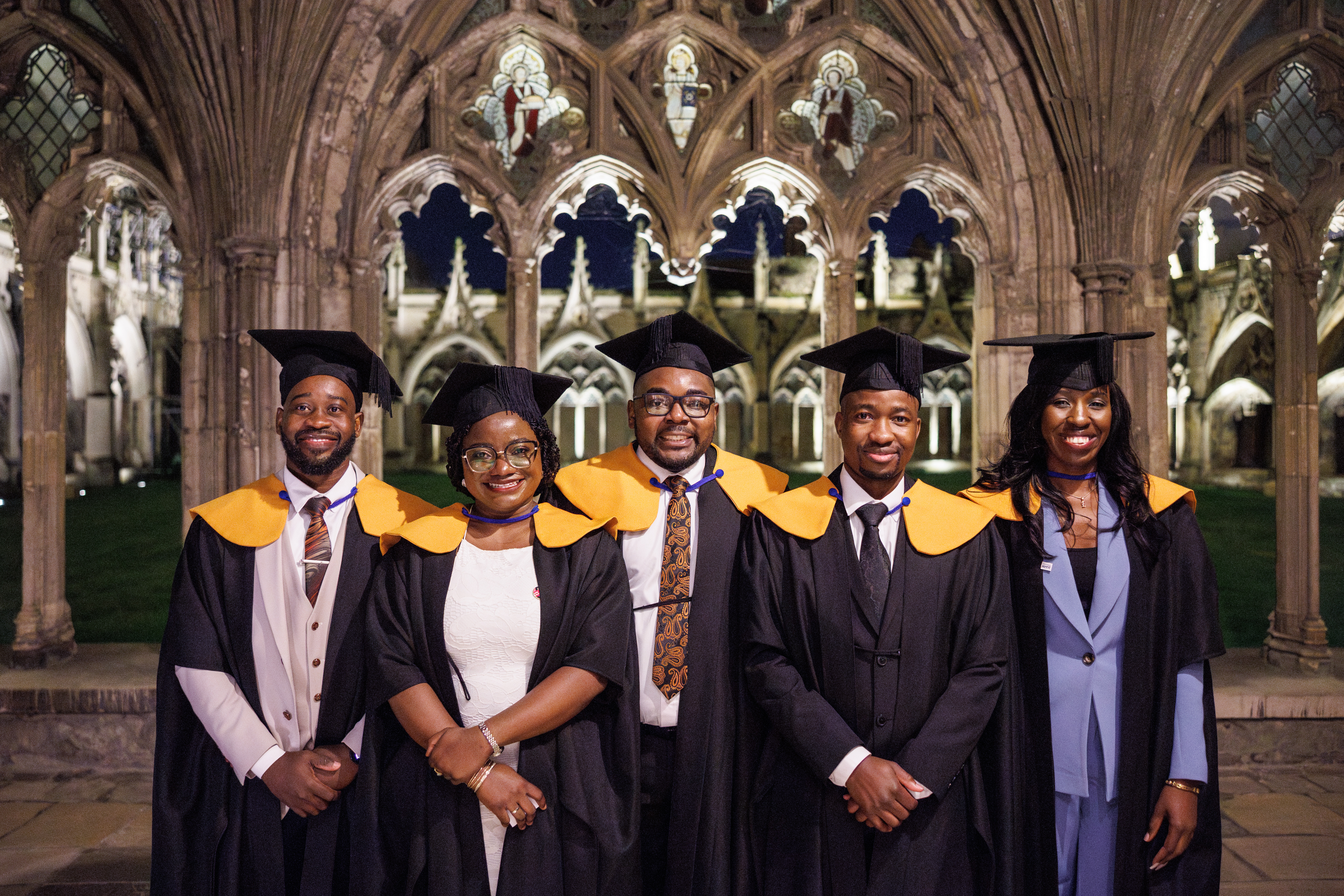
From left to right: Lukumo Luwaile, Constance Banda, Kuzivakwashe Mawoyo, Emmanuel Ncube, Edith January.
Congratulations on your graduation! What has been the highlight from your time at DICE?
Emmanuel: I am very happy, very excited today because I am graduating with a distinction. My time at DICE has taught me a lot. It has helped me to understand things better. I enjoyed the modules that I was studying, mostly Conservation Leadership and also Multidisciplinary Perspectives on Conservation. We met different leaders from different organisations here in the UK and also in other parts of the world. I really enjoyed [it]. It has taught me what real leadership means. It’s not all about theory but about practical aspects in leadership.
Edith: I’ve learnt a lot. I’m so pleased to have pursued the MSc, it’s been brilliant. In terms of the modules, they were related to my work back home. The lecturers were also amazing and a lot of resources were available for us.
Lukumo: The programme has been very interesting and impactful in my conservation journey. I learned quite a lot, especially with my field projects, where I travelled to a field site in the Peruvian Amazon. It was really amazing. I learned a lot in terms of direct interaction with the local communities and the Indigenous People, trying to understand some of the complex issues that communities face.
Constance: The friendships and networks that I’ve made while studying at the University of Kent. I’ve learned so much from the lecturers and from my fellow students. It has been a very awesome journey, very informative.
Kuzivakwashe: I really loved travelling. The Jersey trip and the trip to Arundel, that was really the highlight.
What are you going on to do next?
Emmanuel: I look forward to doing a PhD in conservation.
Edith: I’m leaving tomorrow for Zimbabwe and I hope to implement what I learned here at Kent back home.
Lukumo: I’m looking forward to going out there to do more real conservation work. But also, equally, I have become more ambitious now, hopefully to do a PhD in conservation and ecology.
Constance: I’m hoping to go back home and put the things that I’ve learned into practice. Move the conservation work forward that is happening back home and add more value to it.
Kuzivakwashe: I’ve been working in conservation in Zimbabwe, so the next big thing is to go back and implement all that I have learned here in the field and see what the future holds!
What is your advice to the new cohort of Burnett Scholars?
Emmanuel: Build a network where [you] can. Be able to connect after graduation, I think that’s the most important part – to connect with people, so that you can build your career from there. I believe that successful careers can be built through connection.
Edith: To be bold. Take the step. It’s worth it.
Lukumo: Really work hard. Make sure that you enjoy the journey.
Constance: Take the leap and come here! This is a once in a lifetime opportunity, grab it!
Kuzivakwashe: Just keep locked in, enjoy the time at DICE, enjoy the talks, enjoy the interactions. Have fun!
The Burnett Scholarship is funded through the generosity of the Notsew Orm Sands Foundation, and covers tuition fees, travel and living costs for six mid-career conservationists from southern Africa on our taught Master’s programme. In addition, Burnett funding supports ranger training in the same region.