
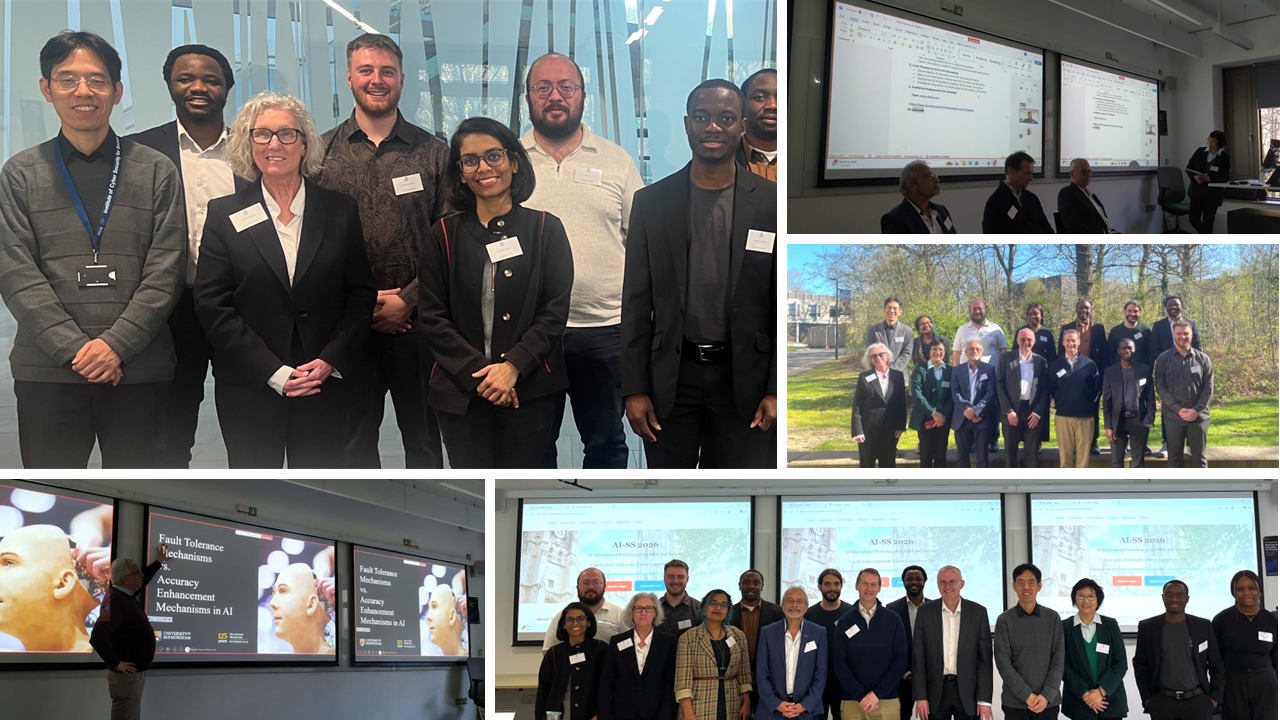
On Tuesday 7 April 2026, iCSS hosted AI-SS 2026 (1st International Workshop on AI Safety and Security), as part of EDCC 2026 (21st European Dependable Computing Conference), in the Sibson Building on the main campus of the University of Kent in Canterbury, UK. Professor Shujun Li, iCSS Director, was the Workshop’s Co-Chair who managed the peer review process and took care of local arrangement matters. The Workshop’s Chair is Professor Hongmei (Mary) He from the University of Salford.
The Workshop was technically sponsored by the following three organisations:
- Institute of Cyber Security for Society (iCSS) at the University of Kent, UK
- Association of British Chinese Professors (ABCP) through its Specialty Committee on AI and Cyber Security
- AI-Cyber Special Interest Group (SIG) of the CRANE NetworkPlus, which aims to strengthen the UK’s cyber security research ecosystem and is funded by the Engineering and Physical Sciences Research Council (EPSRC), part of UK Research and Innovation (UKRI)

The Workshop also received technical support from multiple professional bodies. In particular, the IEEE UK and Ireland Section, eight of its chapters and the Future Networks Local Group helped disseminate the Workshop’s call for papers. The eight IEEE UK and Ireland chapters include the Communications Chapter, Computational Intelligence Chapter, Computer Society Chapter, Electronic Packaging and Reliability Joint Chapter, Robotics and Automation Systems Chapter, Signal Processing Chapter, Society on Social Implications of Technology (SSIT) Chapter, Sensors Council Chapter, and Systems, Man, and Cybernetics Chapter.
The Workshop received 18 submissions from authors in seven countries, from which the following seven papers were accepted and presented at the Workshop in two technical sessions (one in the morning and the other in the afternoon).
- HaiR – A Human-Centric AI Remediation Framework slides
Olayinka Adeboye, Rabab Al Zaidi, Aderemi Adenihun, Segun Akinseye, Lee Speakman and Muhammad Ateeq (University of Salford, UK) - An Empirical Evaluation of Prompt Injection Vulnerabilities in Large Language Models Across Multilingual and Obfuscated Attack Scenarios
Caglar Uysal, Baturay Birinci, Suha Mutluergil and Orcun Cetin (Sabanci Univeristy, Türkiye) - Resilience to Disinformation Among Cyber Security and Information Warfare Professionals: Why Experts May Get it Wrong slides
Allison Wylde (University of Kent, UK), Fabio Petani (Université Bourgogne Europe, Burgundy, France), Issa Issa (ESSCA, France) and Fortuna Cassoria (Université Bourgogne Europe, Burgundy, France) - Leveraging Sparse Intelligence: Large Language Models Can Provide Actionable Priorities From Limited Cyber Threat Data
Osama Al Haddad (Macquarie University, Australia), Muhammad Ikram (Macquarie University, Australia), Muhammad Ejaz Ahmed (Data61, CSIRO, Australia) and Young Choon Lee (Macquarie University, Australia) - Agentic AI vs Non-Agentic AI: Motivation, Security Implications, and Research Foundations slides
Shivangi Gupta, Budi Arief and Rogério de Lemos (University of Kent, UK) - Exploring Agentic AI in Anti-Forensics: Simulation of Evasion Tactics in Digital Investigations
Aderemi Adenihun, Ifeoluwa Ojuolape Oria, Oseodion Ofeimun, Emmanuel Orji, Olayinka Adeboye Adeboye and Segun Akinseye (University of Salford, UK) - Agentic Knowledge Distillation: Autonomous Training of Small Language Models for SMS Threat Detection slides
Adel ElZemity, Joshua Sylvester, Budi Arief and Rogério de Lemos (University of Kent, UK)
In the morning, the technical programme of the one-day Workshop also included a keynote talk on “The Uneasy Marriage of AI and Dependability”, given by Professor Aad van Moorsel, Chair in Decentralised Systems & Head of School, School of Computer Science, University of Birmingham.

The afternoon session of the Workshop started with a panel discussion on “Towards Dependable and Secure AI for Critical Systems”, facilitated by the Workshop Chair Professor Hongmei (Mary) He and participated in by the following four panellists:
- Ali Hessami, Director of R&D and AI, Vega Systems, UK; Chair of IEEE UK and Ireland Society on Social Implications of Technology (SSIT) Chapter
- Gareth Howells, Professor of Cyber Security, University of Essex, UK; Founder, Director and CTO, Metrarc Ltd, UK
- Carl Shaw, Codasip, UK
- Harish Vundavalli, Senior Technical Architect, Strategic Education, Inc., USA

More details about the Workshop’s technical programme can be found at https://cyber.kent.ac.uk/events/AI-SS2026/program.html.
The Workshop Chair and Co-Chair selected one paper to receive the Best Paper Award and another paper whose first author is a student to receive the Best Student Paper Award. Both awarded were financially sponsored by iCSS with a cash prize.
- AI-SS 2026 Best Paper Award: “HaiR – A Human-Centric AI Remediation Framework slides”, authored by Olayinka Adeboye, Rabab Al Zaidi, Aderemi Adenihun, Segun Akinseye, Lee Speakman and Muhammad Ateeq from the University of Salford, UK

- AI-SS 2026 Best Student Paper Award: “Agentic Knowledge Distillation: Autonomous Training of Small Language Models for SMS Threat Detection”, authored by Adel ElZemity, Joshua Sylvester, Budi Arief and Rogério de Lemos from the University of Kent, UK

More photos and links to LinkedIn posts about the Workshop can be found at https://cyber.kent.ac.uk/events/AI-SS2026/photos.html.
We thank all authors for submitting to the Workshop and all participants for attending. We also thank all members of the Organising Committee and Technical Programme Committee, reviewers, EDCC 2026 organisers, and all other helpers and supporters, for making the Workshop possible!