The Godfather, The Sopranos, The Irishman, Scarface, Goodfellas, Casino, Donnie Brasco, Gomorrah, A Bronx Tale, Once Upon a Time in America, and, closer to home, Legend, taught many of us how to imagine organised crime before we ever read a court judgment. They have given us dark restaurants, family dinners, long funerals, whispered betrayals, patriarchs in expensive suits, disturbing scenes of violence, some funny moments and a world where power moves through blood, loyalty, revenge, fear and money.
This is the mafia: cinematic, brutal, seductive and frightening. We think we know its rules, its families, its codes, its hand gestures and its silences.
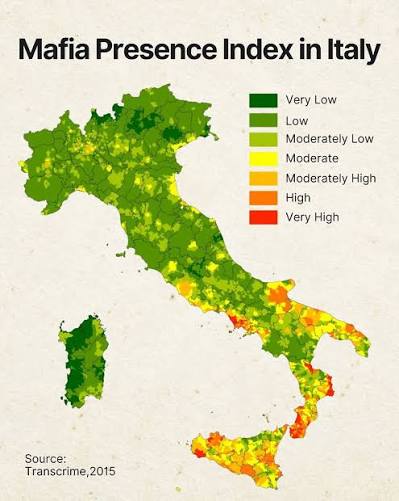
We also think we know something else: that the mafia is Italian. Just as Dante, Leonardo da Vinci, Michelangelo, Raphael, Galileo, Machiavelli, Caravaggio, Vivaldi, Christopher Columbus, Marco Polo, Amerigo Vespucci are all “Italians”. Yet many of these figures were not. They were born, and lived, before Italy existed. They belonged to Florence, Venice, Genoa, the Papal States, the Kingdom of Naples, or other political worlds that were not yet “Italy”.
So, to remain geographically pertinent, let us give Caesar what is Caesar’s.
Italy is a young state, a young child of the old continent. The United States declared independence in 1776. Italy became a unified kingdom only in 1861… about 100 good years after… and only about 165 years ago. Before then, the peninsula was a patchwork of kingdoms, duchies, city-states, papal territories and regional identities. There was no Italy. I know … in the common imaginary Italy feels ancient … but the Italian State is not and it is, politically speaking, a nineteenth-century creation.
This matters because the mafia, too, is often treated as though it emerged from some eternal Italian essence, as if it had been slowly cooked from blood, family, red chilli and gunpowder, on a stove fuelled by the southern heat and then glossed with extra virgin olive oil. But what if that story is too easy? The mafia, as a political and legal category, is not something praetorian guards discovered. It is something the modern Italian state constructed.
The formation of Italy through unification was no romantic national embrace, as it is often portrayed. Some territories entered the new kingdom just before 1861 through plebiscites and political negotiation. Others, as the former Kingdom of the Two Sicilies and therefore much of the south, experienced unification through conquest, military occupation, bloodshed and civil conflict. The south did not simply become Italy. It was made Italian, by sheer force.
After unification, the newly established Italian state faced a certain natural resistance in the Mezzogiorno due to political opposition, rural poverty, refusal of conscription, loyalty to the old Bourbon kingdom, local banditry, land conflict, social unrest and anger towards an Italian State that arrived more as conqueror and a coloniser rather than a protector. Yet there the law compressed this resistance into one threatening word: “brigandage”, a brutal word that prepared the ground for another equally brutal word: “mafia”.
These words were not innocent. Once the south could be named as a land of brigands, camorrists and mafiosi, it could also be governed as a land of danger. The problem was no longer only poverty, dispossession, political resentment or the violence of unification itself. The problem became the southern subject who was purposely portrayed as unruly, backward, criminal, in need of discipline. Once named in this way, the south could be treated not as part of the nation to be listened to, but as a territory to be colonised, pacified, governed and controlled. Thus, one of the first major legal acts of the new Italian State was the Pica Law of 1863, which authorised extraordinary measures against brigandage and camorrism only in the newly acquired southern regions. Military tribunals, collective punishments, forced displacement and property destruction became tools of state-building. The law helped produce the named “disorder” as a legal category that justified exceptional state violence.
Here, the story of the mafia begins to look different. The power of The Godfather begins to fade, and what comes into view is the troubled relationship between the Italian State and its own people from the South. Violence, intimidation, private protection and local power were and are real. But they existed in a world where the Italian State was indeed, distrusted, often predatory, and unable or unwilling to offer justice, security and economic survival to large parts of the south and its population.
In villages, markets, land disputes, elections, alternative powers flourished. Some mediated disputes. Others offered protection. Some controlled access to land, work, markets or political influence. Others became violent and parasitic. Most moved between that legality and illegality defined by Turin and Rome. These were not yet the mafia of cinema, nor even the mafia of modern criminal law. They were local formations born out of the ruins of distrust between people and state, between centre and periphery and between law and survival.
Soon after unification came migration. More than 26 million people have left Italy between unification and the late twentieth century, especially from the south. People left for the same reasons people have always left home: poverty, conflict, lack of work, absence of accessible agricultural land, lack of hope and absence of justice. Today, around 59 million people live in Italy, while about another 80 million of Italian descendants still live abroad and these come mainly out of the Italian southern territories. Thus, the Italian story became global, but so did the stereotypes attached to it. The poor southern migrant, the uncivilised dangerous southern man, the family clan, their code of silence, their ‘mafiasis’.
The Italian state, meanwhile, continued to imagine the south as the land of the suspects. Even under Fascism, Cesare Mori, the “Iron Prefect”, was sent to Sicily in a crusade against the mafia. His campaign was celebrated as proof of state power, but it relied on mass arrests, intimidation and the suspension of ordinary guarantees. Once again, the south was treated as a place where normal rules could be usurped in the name of national salvation. Is this still the case? How does mafia relate to this history, and what role does it continue to play in 21st-century Italy?
It relates because mafia was and is a category that has given the Italian State its own story to tell. A story that, perhaps polished and enriched, is still told today. Instead of asking how poverty, conquest, mistrust and uneven development shaped southern life, the state could point to criminality. Instead of confronting its own violence after unification, it could describe the south as violent and in need of control. Instead of asking why people distrusted the law and left their homes, it could criminalise the social worlds that grew where its imposed law had failed. Instead of asking why such a dramatic divide persists between North and South, it can point its wee finger at the ever-present, all-embracing mafia, thereby avoiding any politically charged questions of responsibility.
Hence, the story is still here but it remains incomplete… if we imagine the state only as the brave enemy of the mafia. The state was never merely the witness to the mafia’s genesis. Its shadow fell across the cradle. It named, classified, punished and often misunderstood the south. It turned political resistance into brigandage, social complexity into deviance, and southern difference into danger and thus ‘mafia’. By the time modern anti-mafia law arrived, this established language was already in place. Words such as intimidation, subjugation and omertà carried a much longer history which was a history in which southern silence, loyalty, kinship and local belonging had already been treated as suspicious.
Do not get me wrong: crimes labelled as mafia crimes are part of a complex and brutal reality, and films about the mafia will undoubtedly continue to fascinate us. But the real story is not only in the restaurant, the courtroom or the back room where deals are made. It is also in the birth of Italy itself.
And sometimes, the most powerful “family” in this mafia story is not the Corleones, the Sopranos, the Krays, or the Camorra clan. It is the family of legality itself, and the categories through which it forced us to see and judge the Italian south.
Antonino Serraino is a PhD candidate at Kent Law School.