
Henna Masih is a PhD researcher in law exploring how women of colour legal academics experience and narrate interlocking structures of race, gender, and class, revealing what their affective accounts tell us about institutional inequality in the British legal academy.
In this post, I reflect on the “messiness” of analysing qualitative data in sociolegal empirical research, including what it means to be an embodied researcher, and argue that Braun and Clarke’s (2022) Reflexive Thematic Analysis embraces this messiness as part of the method, rather than trying to manage it away. I draw on my PhD study, which pairs Reflexive TA with a theoretical framework combining Black feminism and Sara Ahmed’s work on affect and emotion, to illustrate what this looks like in practice.
Reflexive Thematic Analysis: A method that expects messiness
Reflexive TA sits within a qualitative interpretivist paradigm – a “Big Q” fully qualitative approach to qualitative methods. This rejects a positivist logic, including both the ontological assumption that an objective reality exists, can be understood, and measured, and the epistemological belief that researchers should be value-free. 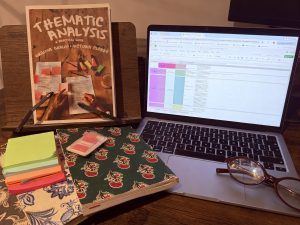 Reflexive TA embraces subjectivity rather than casting it as a form of bias, meaning there is no single correct reading of the data. Moreover, pre-existing themes do not emerge from the data, rather they are actively constructed by the researcher through their engagement with it. Consequently, creativity sits alongside rigour, analysis is seen as an art rather than a science. Reflexive TA, is also an interpretive process where subjectivity is valuable: the researcher’s values, assumptions, standpoint, and theoretical approach help shape the analysis. However, this is underpinned by also being a reflexive researcher, which is the foundation of reflexive TA and continually questioning how your positionality shapes your analytic choices.
Moreover, because Reflexive TA is an analytic method rather than a methodology, theoretically flexible, it does not have its own theoretical commitment, allowing researchers to apply frameworks that address the complexity of their research. For instance, I adopt a Black feminist approach, particularly Patricia Hill Collins conceptualisation of the matrix of domination to draw on intersectionality, alongside Sara Ahmed’s work on affect and emotion, such as affective economies. This shapes what I listen for including how race, gender, and institutional power intersect, how emotion circulates, and how these individual accounts point to structures.
While Braun and Clarke outline a six-phase process that acts as a tool to guide researchers through analysing their dataset – (1) familiarising yourself with the dataset, (2) data coding, (3) generating initial themes, (4) developing and reviewing themes, (5) refining, defining and naming themes and (6) writing up – this is not a linear formula, but rather flexible and recursive.
Feeling as data: affect and the active researcher
Returning to the fact that themes are generated through researcher engagement with data in reflexive TA, I want to emphasise the significance of the researcher’s embodied response to the analytic process. For instance, in my research I encountered feelings of frustration, sadness, realisation and hope. According to reflexive TA these affective responses are not problematic obstacles to rigorous research, but reflexive points to consider that illustrate how my positionality and the data meet. Therefore, a reflexive TA approach means playing an active role as a researcher in generating codes and subsequent themes. This involves being a situated researcher, cognizant of how my researcher positionality is shaped by my gender, race, personal experiences and values. For instance, being a Brown British woman doing a PhD in law inevitably influences my research on inequalities faced by Women of Colour legal academics, shaping how I code and which themes I develop.
Moreover, reflexive TA’s emphasis on immersion in the data and listening back to audio multiple times rather than conducting analysis solely from the text, allowed for me to attend to not only what was said in interviews, but also the tone, pauses, laughter, and fatigue. Attending to these features is important for my research because I pair reflexive TA with Black feminist thought, and Sara Ahmed’s work on affect and emotion namely affective economies. Within this framework, lived experience is a legitimate source of knowledge and emotions are not merely private individual, psychological states but relational, social, and cultural practices, that shape norms, cultures of belonging, and relations of power, making this analytically significant. For instance, shared moments of laughter when discussing experiences of workplace microaggressions is important reflexive data. These reveal moments between my participants and I, where stories could be funny because they were so absurd, and the laughter was a form of mutual recognition.
An embodied experience of analysis and self-care
Trawling through endless transcripts, handwritten reflexive fieldnotes, and listening to hundreds of hours of audio involving sensitive data relating to inequality can lead to feelings of heaviness and overwhelm, subsequently affecting how we interact with our data. Therefore, it is important to acknowledge the limits of our energy and mental load as researchers and take breaks from the process to prevent burnout.
Alongside immersion in the data, a reflexive TA encourages a recursive slow approach where uncertainty and discomfort are embraced as part of the analytical process with analysis only finalised when writing up. Working slowly can feel uncomfortable particularly in an increasing academic and neoliberal culture of urgency. However, it is this slowness that minimises the risk of analytic foreclosure and allows me to notice what might otherwise be missed.
To conclude, for researchers working with complex, affect-laden data, the question may be less how to make the process tidy and efficient, but rather how to stay with it long enough to learn from it.