
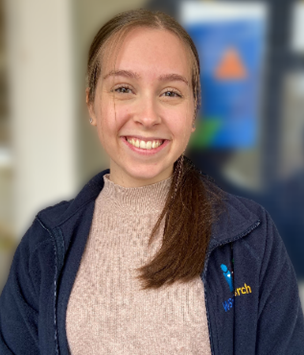
What drew you to Clinical Trials Specialist apprenticeship?
I was looking for a change. I previously worked in an optician but there were limited opportunities for progression, and I knew it wasn’t something I wanted to do long term. I’d always been interested in working for the NHS, and one day I came across an apprenticeship opportunity on their website. At the time, I didn’t know much about clinical trials and had never worked in healthcare before, but I did some research and decided to apply.
I submitted my application during COVID, when there was a lot of focus on vaccine trials and health research, which made the role feel even more relevant. The opportunity to gain practical experience while earning a degree, all without needing to relocate, really appealed to me.
Why did you choose the apprenticeship route instead of a traditional degree?
I didn’t go into this straight from college, and I never really knew what I wanted to do. After finishing college, I went travelling and then started working in an optician. By that point, I was used to earning, and going to university felt like a step backwards since I was already working full time. I wanted to keep building my experience while continuing to get paid.
I’ve always been someone who likes to work, and an apprenticeship offered the perfect balance to earn and learn at the same time. It didn’t make sense to give up a salary to study full time, especially as I was saving for a house. Being on the apprenticeship has made that possible, and I’ve now managed to buy my own home, which wouldn’t have been achievable if I’d gone to university.
What was the application process like?
The application process was very straightforward. I applied through the NHS website, just like any other job. After being invited to an interview, everything went smoothly, and I was offered the role quite quickly. It took a few months for HR to finalise the process, but once I started, I began the application for the university side.
Next came the university onboarding, I had to complete a few forms and have my employer sign theirs but overall, it wasn’t any more complicated than applying for a standard job.
What does a typical day or week in your role look like?
In my role I run multiple studies, so what I do depends on the day. I usually come in and check my inbox to make sure there’s nothing urgent that needs my attention. Then I’ll start by screening patients to see who’s eligible for the studies I’m managing.
For example, one of my studies is surgical, so I’ll look at the theatre list to see who’s coming in and who might be eligible to take part. I’ll then approach those patients to see if they’re interested in joining.
Once patients have been screened, I’ll often follow up with them to take informed consent over the phone and filling in the paperwork for that. For example, uploading consent forms to their medical records, documenting everything properly, and updating our systems to record that they’ve been recruited. We have to complete a Case Report Form (CRF), which is basically a booklet containing all the data the study needs. I’ll fill this in using information from the patient’s medical notes, things like blood test results, medications, and other relevant details.
Some days I’ll have study visits, which means seeing patients in hospital to collect data. This could be through a questionnaires or other assessments, depending on the study. For some studies, I also take consent face-to-face when patients are admitted.
I manage several studies across different specialties, mainly surgical and gastrointestinal, so my work involves a mix of screening, recruitment, taking consent, collecting data, database management and handling any data queries that come up later.
The other part of my role focuses more on governance. That means making sure we have all the necessary ethical approvals and documentation in place before running a study. I also liaise with hospital departments to make sure they can support the research. For example, if a study requires an X-ray, I’ll contact the radiology department to confirm they have the capacity to help, get their approval, and then file that documentation appropriately. It’s all about making sure everything is in place so the study can run properly and safely.
Can you share an example of a project or task you’ve been involved in?
I’m working on an oncology project at the moment, which is a cancer trial. It involves patients coming into hospital for endoscopy procedures, such as colonoscopies or OGDs (which are procedures down the throat). These patients are eligible for the study because they’ve been referred on the two-week pathway, meaning they’re being investigated for suspected cancer, so they come through quite quickly.
The study is testing a new machine that has been designed to detect traces of cancer from a breath sample. When patients come in for their endoscopy, we ask them to blow into a special bag. The machine then draws in the air from the bag and analyses it to identify tiny molecules in the breath which can indicate the presence of cancer.
The aim of the study is to verify whether this machine can detect cancer as accurately as the endoscopy procedure. If it proves reliable, the long-term goal is for these machines to be used in GP surgeries. That way, when a patient visits their GP with symptoms that might suggest cancer, instead of being referred straight onto the two-week cancer pathway, which can be stressful and involves uncomfortable procedures like colonoscopies, they could simply take a breath test.
The machine would then analyse their breath and give a result indicating whether cancer is likely present, and even which part of the body it may be in, such as the liver or colon! If the result suggests cancer, the patient can be referred quickly for further investigation. If it shows no signs of cancer, it saves the patient unnecessary worry and reduces pressure on hospital services.
How do you balance time between work, study, and personal life?
It can be difficult, and you have to be disciplined and really make the most of your study day. At the start, it’s easy to think, “Oh, I’ve got a day at home,” but it’s not a day off. Self-directed learning can be challenging, so you need to be strict with yourself and use that time wisely.
I always made sure to set boundaries too. I kept at least two or three evenings a week completely free from university work, no matter how busy I was. I made time to do things for myself, like playing sport a couple of times a week or having downtime on weekends.
When I was studying, I had to work some evenings or weekends, but I tried to keep a balance. For example, I might take Saturday off and then do some university work on Sunday, so I was keeping up with deadlines but still having a life. It really depended on what was going on. When there was coursework due, I would work more hours, but once that was handed in, things would ease off until the next module.
How have your employer and training provider supported you throughout your apprenticeship?
My employer has been really supportive and flexible. They’re very understanding if I have a lot going on with university work and are happy for me to set aside time to focus on that. They also make sure not to overload me with clinical tasks during busy periods because it can be too much. I’m the first person to do this apprenticeship in my team, so it’s been a learning process for all of us.
On the university side, the academic staff are incredibly approachable and supportive. There’s no such thing as a silly question, and it genuinely feels like they want the best for you. They respond quickly to emails and are always happy to arrange a meeting if you need extra help.
Having an apprenticeship advisor has also been a great source of support. It’s reassuring to have someone checking in and making sure you’re staying on track.
What skills (technical or personal) have you developed the most since starting?
I’ve gained a wide range of skills through this experience, from communication and teamwork to leadership and organisation. One of the biggest changes has been in my confidence. When I first started, the idea of approaching a patient in hospital to talk about a study would have made me nervous. Now, I feel comfortable and well-informed enough to have those conversations and answer any questions they might have.
Alongside that, I’ve developed strong clinical knowledge and practical skills such as taking bloods and carrying out ECGs. Managing several studies at once has also taught me how to stay organised, balance priorities, and keep on top of multiple responsibilities.
I’ve also had the opportunity to build leadership skills by training student nurses and people on work experience, helping them understand what we do. More recently, I’ve been part of interview panels for research nurses and governance team members, which has been a completely new and valuable experience for me.
What are your next steps or goals once you finish the apprenticeship?
I really enjoy my job and the team I work with. After the apprenticeship, I hope to continue doing what I’m doing now, but in a full-time role.
I’m looking forward to focusing fully on my work for a while and continuing to develop my skills. I’m not saying I’ll never study again, but I’d like to take a break from studying for a few years to gain more experience first.
What advice would you give to someone considering a CTS Apprenticeship?
I’d say the main thing is to pace yourself and be kind to yourself. It is a lot, working, studying for a degree, and trying to live your own life, so it’s important to take time for yourself and not feel guilty about it.
Always ask for help if you need it. There’s no point in struggling in silence, because both the university and your workplace want to see you succeed and are there to support you. Talk to people about how you’re feeling and speak up when you need help. Most importantly, go for it! The apprenticeship is definitely worth doing.
Contact us
Has Chloe’s story inspired you to hire an apprentice? Please contact us on recruitapprenticeships@kent.ac.uk to learn more about how we can support your workforce development needs.