Monthly Archives: November 2010

A church, some carols…and Skempton

A miserable night yesterday: dark, windy, cold and raining.
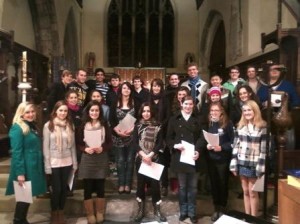
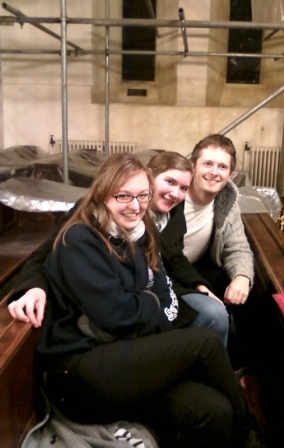
Inside St. Mildred’s Church, however, light, music and jollity abounded; we had battled the elements in order to hold our customary Tuesday night rehearsal in the church, in order to work without a piano and to get a sense of the space and the acoustics for the concert.

The antiphons are developing: a little more confidence in delivery is needed here; singing plainchant is a skill that requires initial groundwork, and many have not sung this style of music before; a combination of flexibility in the line, following the rise and fall of the speech, as well as confidence in taking responsibility for the line and doing so at the same time as everyone else. Tricky – it requires a lot of work to appear effortless!

The carols are progressing, too; singing in the acoustic of the church meant we could really start to draw forth a full ensemble sound from the group, balance the parts, and begin to explore bringing out specific notes and phrases in particular voices. Bethlehem Down especially is starting to develop some three-dimensionality as it lifts off the page, and with some sensitive dynamics starting to be included, it’s going to be a treat.
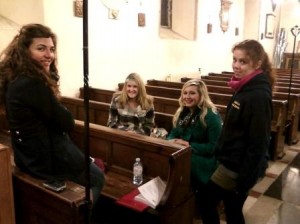
The final singing of the evening was a chance to re-visit Skempton’s He Wishes for the Cloths of Heaven. It’s not a Christmas piece, it’s not in the Advent service in a few weeks’ time – in fact, we’re not actually singing it until February. But this was too good an opportunity to miss: the chance to sing it in a sonorous acoustic, arranged in a crescent-shape similar to the way we’ll be standing to perform in the Cathedral Crypt. (And besides, I love the piece, so any opportunity to sing it is welcome indeed…). We took it a fraction under-tempo, as it’s been several weeks since we first sang it, and this is only the second reading; this meant the chords hung in the air for just a little longer than usual, and the colours really had a chance to blossom. It worked so well, in fact, that I’m wondering whether it shouldn’t go at that speed in performance; it’s marked Andante, but perhaps my enthusiasm has pushed the speed slightly ? Something to think about…

(Don’t tell the composer…).
Ask or tell ? Relating to a choir

A series looking at the art of the choral conductor.Conducting

How should  a conductor relate to their choir: should they ask them to create a sound in the manner they conduct, or tell them ? Should they invite a response from the choir, or should they demand it ?

The days of the dictatorial conductor are long gone; no more the total authority of a Karajan, or the sheer force of a Solti, famously nick-named the ‘Screaming Skull.’

Ensemble musicians need to feel that they are being developed, even in a large-scale ensemble like an orchestra or a choir. A conductor who imposes his will by brooking no arguments can make his musicians feel that they are being given no room to develop themselves if they are simply forced to play in the manner someone else dictates. Musicians at La Scala famously rejected Maestro Muti on the grounds that, although he is a world-class conductor, they felt they weren’t being given the ability to develop as players: they were simply doing what they were told all the time.

A conductor should always bear in mind that conducting is an ensemble event: you need the singers or players to perform not just for you, but with you.

The best compliment I ever received as a student conductor at university was from someone who remarked that, in directing a group of musicians, the way I brought them in was in a manner that invited them to play, rather than told them ‘right, you’re coming in NOW!’ This has really stuck in my mind, and I think is perhaps a technique that should be remembered: ask your singers to give of their best, rather than tell them they have to be giving it.

As a conductor, I feel my job is done when the choir can perform without my standing in front of them at all. They have the confidence, the experience, and the trust in one another to perform almost without being directed. On these occasions, my job is simply to remind them of what we’ve rehearsed – dynamics, phrasing, etc. – and cajole them into doing what they know they can already do.

Let them fly, and they’ll take you with them into greater heights than ever they would have, had you been driving them along instead. Ask them.

The Austro-German Connection: Brahms and Bruckner

This week, the Cecilian Choir arrived at the Austro-German part of their programme; pieces by Brahms and Bruckner. Bruckner’s Locus iste is a hardy perennial, and gave the choir a chance to work on their vowel-shapes and sustained phrases. The third section is wonderfully chromatic and harmonically uncertain, ‘irreprehensibilis ist,’ and we strove to capture some of that hesitancy in both the dynamics as well as in the unfolding chromatic lines: there’s a tendency to want to crescendo too soon, but holding back and only reaching mezzo-forte before subsiding back to piano for the reprise keeps the excitement of the passage.

The foggiest notion: Der Wanderer über dem Nebelmeer, Friedrich

The Wanderer: Caspar David Friedrich

From Latin text to German: Ach, arme Welt by Brahms, and a chance to develop the linguistic skills of the choir by getting to grips with German. This chorale has some great colours to enhance the text – ‘’Du falsches Welt, du bist nicht wahr (You false world, you are not real) and ‘’Mit Weh und grossem Leiden (with pain and bitter anguish);’’ wonderful lines to sing in German. The most striking aspect of the piece is that, full of impassioned power and dynamics and crescendi, at the last phrase ‘hilf mir, Herr, zum Frieden (help me, Lord, to peace)’’ the piece ends with a diminuendo and ends piano on the final chord. After all the Sturm und Drang of the rest of the piece, it’s a great trick and creates a rapt ending.

We left German Romanticism behind and ended by returning to French neo-Classicism to revisit the first part of the Poulenc that we’d looked at last week. It’s still a terrific piece: I’m delighted we’re learning it.

Sweet singing in the choir: carols in rehearsal five

Ah, the carols for Christmas. Comfortingly familiar, and yet so familiar that everyone sings what they know, which occasionally isn’t necessarily what’s on the page!

Carol singersThe anthologies having arrived, this week was the chance to get in a festive mood by working on the carols for the Advent service looming around the corner. To start, Ding, dong merrily on high! and the opportunity to work on sustaining the long phrases on ‘Gloria,’ and to get the bell-sounds pinging off the page – as with the Vaughan Williams ‘Full fathom five,’ there needs to be a really percussive ‘d’ to the ‘ding’ and bright vowel-shapes to get the notes crisp and vibrant, rather than heavy and dragging.

The Angel Gabriel from heaven came needs real shape and direction in the long, legato wordless chords in the lower three voices; in order that the phrases have some meaning and don’t lose momentum, we worked on pointing them towards particular chords. The carol is full of lovely accented passing-notes and dissonances resolving as the parts keep moving, with florid lines in the alto and tenor voices in particular.

The Holly and the Ivy offered a multitude of land-mines: there are crisp dotted rhythms in some bars that need to be quite different to the gentle triplets sung in other voices at the same time. There are some terrific flowing lines in the lower voices, although sometimes the basses weren’t always quite sure where the lines were going – there were some moments where they weren’t quite as confident as they were elsewhere, and sometimes one heard ‘Oh, the ner ner hmm hmm da di  SUN! And the hmm pom some-thing da di DEER!’ which caused some hilarity. However, by the time we’d finished working on it, the carol was in great shape, in particular the delicate coda that extends ‘sweet singing in the choir’ with some lovely harmonies.

Thence to a first look at one of the Crypt concert pieces: Gabriel Jackson’s To Music.  This is a marvellous piece, full of rhythm and dance and joy; it moves at a terrifying pace as well! But this was our first encounter, so we started halfway through (reasons for this in a forthcoming post in the ‘Not drowning but waving’ column) and looked at the ‘Fall down’ section rather slowly. The divisi soprano parts peal like bells over one another throughout, with tolling chords in split tenors and basses and altos chiming their descending phrases in the middle – a terrific passage, that came together very quickly at rehearsal tempo. We then took a cautious dip into the opening 5/8 section to get a sense of what is to come.

The last two carols, I saw three ships and O Come, o come Emmanuel having been sung as well, we’ve now covered all the music for the Advent concert. We ended the rehearsal by singing through Ding, dong merrily… again – it’s always good to end with something the choir can sing well, to end on a positive note – and, with heads now out of the copies and the choir looking up and singing out, the transformation was immense. It will be the last piece in the concert, and promises to be a vibrant finish.

Hopefully, the rehearsal either next week or the week following will be at the church itself, St. Mildred’s, which will give us the chance to explore the acoustic properties of the performance space and get accustomed to the sound in the church before the concert; exciting times…