 By
By 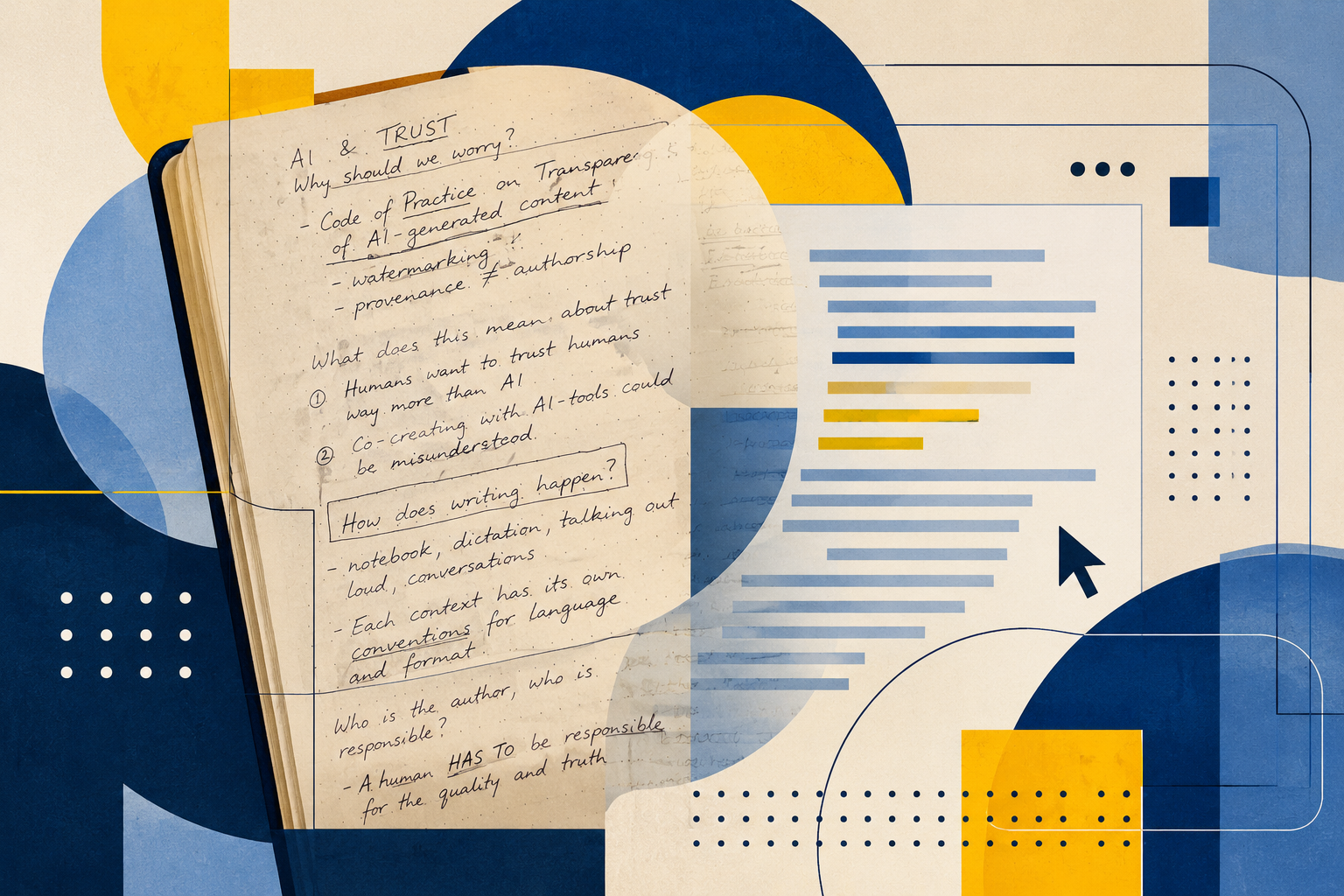
A colleague sent me some technical documentation. It was AI-generated, checked, professional and useful. Why would I worry?
A colleague published a blog article. It’s well-written and coherent and expresses important and useful thoughts. I can tell it’s AI-written. Should I worry?
Online, I see a fun video of cute kittens squeezing into small spaces. I am not 100% sure if this is AI-generated or not. Should I worry?
The EU has recently brought in the Code of Practice on Transparency of AI-Generated Content, which includes transparency requirements to mark some content that is generated by AI.
In August 2026, Claude (Anthropic AI) announced that it would start watermarking AI-generated content. But when you look at their announcement in detail, it’s interesting. Anthropic says it will watermark more than the Code of Practice requires, including some categories the Code explicitly exempts.
Does a watermark tell us enough about the ideas and judgement behind a text, video or image?
It’s not a real binary of human-written versus AI-generated content. Especially when we write, the line is blurry. Even if the watermark for AI can tell us about provenance (was AI involved?), it cannot neatly mean that authorship is also by AI, because provenance and authorship are not the same.
What does this mean about trust?
① Humans want to trust humans way more than AI
② Co-creating with AI tools could be misunderstood
Take this article. It started out as handwritten scribblings in my paper notebook.
Writing screen-free considerably helped me go slower, read my sources more thoroughly, and develop my thoughts and arguments. And writing AI-free helped me get a feel for exactly what I want to say and which points are most important to me.
But my original paragraphs are annotated, chaotic, all over the place. Without a range of edits, restructurings and rewrites, I would not be able to present a well-organised article that’s easy to follow and read.
For many people (and me), edits are a tedious, draining part of writing. The same goes for typing up handwritten notes. As a result, I decided to use ChatGPT Edu to help me create something well-written.
You know who the author of this article is: me (Kerstin Cable from the AI team).
But if you detect an ‘AI Tell’ in it, you might become unsure if I did write it.
Here is how my writing process went.
I want to share it in detail so you can form your own judgement about where and how AI was involved.
- Handwrite out a first draft in my notebook. Research a few developments I reference, such as the EU’s Code of Practice on Transparency of AI-Generated Content

A peek at my original notes - Take a photo of all my handwritten notes and upload them to ChatGPT Edu, asking for a conversion of the handwriting to text on the screen. Ask AI to maintain my exact wording and change nothing in the text.
- Check whether the AI tool changed anything. Ask for an editable version of the text so I can make corrections where the tool read my handwriting wrong or left a gap marked [unclear]. There is quite a bit of this, because my handwriting isn’t super clear. This is a lot faster than typing it up. In this first pass, I also connect thoughts that had been written out of sequence.
- Ask for copy-editing in line with the university’s writing voice. I did not let AI make any changes and instead requested approval for each suggestion. This way I’m also teaching AI what I’m trying to say, catching omissions in the earlier first pass, and revisiting my arguments.
- Next, an editor’s logic check. I ask it to check my arguments, my logic and the way I build my argument, like an editor reading something.
- Download the text as a Word document and work through the points ChatGPT made about where my argument can be strengthened. In the process, I also re-read my text, make my own small edits, and add a new conclusion.
- Paste the edited version of my article into the tool, asking once again for feedback on my arguments and logic. Then edit in the text processor, giving it another read in the process.
- I pick out the occasional sentence I don’t like yet or find unclear, and test whether ChatGPT Edu can suggest a clearer way to say it. If I decide the sentence is an improvement, I paste it into my article. This helps me retain the original meaning of my statements.
- Finally, I ask my (human) colleague to read the article. This is the most intimidating part of the process.
- I edit once more after the human input, then ask ChatGPT Edu to summarize my article and its main argument. Just to make sure I hit the points I wanted to make.
In this process it was important for me to ensure that my words stay my own words, instead of having AI rewrite and rephrase everything I wrote.
I don’t think that it follows from this process that I am expressing myself in the “very best” way. English isn’t my native language, and I have my own cognitive challenges, after all.
But these imperfections are a deliberate signal of what makes my thinking and judgement human. In a discussion about trust, this felt like a good idea to me.

How does writing happen?
I don’t always start thinking by hand in a paper notebook.
Sometimes I might dictate, think out loud, talk to colleagues or even go back and forth in a conversation with ChatGPT Edu.
People develop thoughts and language in all kinds of ways, and then we translate it into a ‘dialect’ that is appropriate for the place we want to share it.
Each university assignment, formal report, social media post, announcement and poster has its own conventions for the language and format to use.
Everything that’s on our minds — all that brilliance, beauty, erroneous, right or wrong thinking — gets translated. And that translation function is different to ‘generating’ content with AI.
However, the line again blurs where AI tools introduce new ideas, claims and language that didn’t originate with the author.
Who is the author, who is responsible?
Now, what the EU, this blog post and even Claude’s new watermarking process all come back to is this:
A human HAS TO be responsible for the quality and truth of AI-generated content if we are expected to judge that something we read is trustworthy.
It’s not enough to generate an output, glance at it and publish.
If I have AI generate an article about this and confidently read it out on camera, you may trust it more than if I just leave an em dash in (em dashes are considered an ‘AI tell’). That is clearly nonsense.
We don’t automatically distrust a politician because they’re reading an elegant speech they didn’t write.
The question is not about whether someone used AI or ‘did their own work’. This is often seen as a binary division when it doesn’t have to be.
Copy edits, idea exchanges, developing our writing: these are all valuable activities and can benefit from AI assistance.
The line, however, is one we humans haven’t learned to ‘feel into’ yet, because AI is still so new as a writing and thinking tool: when has human judgement been superseded by AI?
That leads to a more uncomfortable question: am I reading something false or fabricated?
I’d argue that the significant issue isn’t AI slop, the existence of AI or even how the technology works. It’s the trust signal.
A few AI tells, like em dashes or a pseudo-lyrical collection of short sentences with rhythmical phrasing, can now be enough to cause a reader to distrust any text, even if it’s been well researched and thoroughly thought out.
AI sends a different trust signal
When a human writes, we know how to read it critically. We know that humans can lie, mislead, and repeat errors, and that it can be done inadvertently or even purposefully in order to deceive.
When AI does, we have no clue. Generative AI is a software tool much more than a conscious author and approximates repetitions of what it has seen before rather than judging independently if a fact or sentence is wrong or right.
Finding your line
We find ourselves in a fascinating, slightly scary moment of human interaction with a new tool.
It’s essential to make yourself aware that AI tools cannot judge the truth or accuracy of any person’s claims. They may well reproduce accurate facts, but they don’t know if those are facts and truths.
Institutions and AI companies are beginning to grapple with this new challenge to human trust, possibly with a few blunt tools that may not get the balance of trust right immediately.
The line is blurry, and the best thing for you as the reader is to stay critically engaged, educate yourself about how AI works and every now and then get the paper notebook out and write and think 100% offline.
Where is your line?